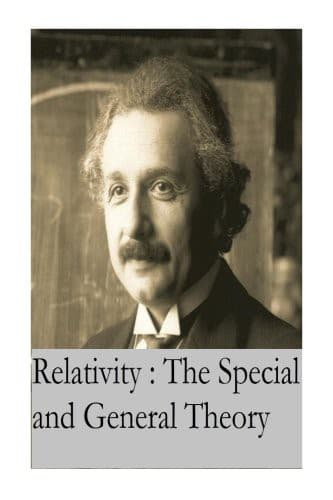
Relativity: The Special and General TheoryEinstein, Albert
Science
Relativity: The Special and General Theory
Einstein, Albert
Relativity (Physics)
If we drop these hypotheses, then the dilemma of Section VII
disappears, because the theorem of the addition of velocities derived
in Section VI becomes invalid. The possibility presents itself that the
law of the propagation of light _in vacuo_ may be compatible with the
principle of relativity, and the question arises: How have we to modify
the considerations of Section VI in order to remove the apparent
disagreement between these two fundamental results of experience? This
question leads to a general one. In the discussion of Section VI we
have to do with places and times relative both to the train and to the
embankment. How are we to find the place and time of an event in
relation to the train, when we know the place and time of the event
with respect to the railway embankment? Is there a thinkable answer to
this question of such a nature that the law of transmission of light
_in vacuo_ does not contradict the principle of relativity? In other
words: Can we conceive of a relation between place and time of the
individual events relative to both reference-bodies, such that every
ray of light possesses the velocity of transmission _c_ relative to the
embankment and relative to the train? This question leads to a quite
definite positive answer, and to a perfectly definite transformation
law for the space-time magnitudes of an event when changing over from
one body of reference to another.
Before we deal with this, we shall introduce the following incidental
consideration. Up to the present we have only considered events taking
place along the embankment, which had mathematically to assume the
function of a straight line. In the manner indicated in Section II we
can imagine this reference-body supplemented laterally and in a
vertical direction by means of a framework of rods, so that an event
which takes place anywhere can be localised with reference to this
framework. Similarly, we can imagine the train travelling with the
velocity _v_ to be continued across the whole of space, so that every
event, no matter how far off it may be, could also be localised with
respect to the second framework. Without committing any fundamental
error, we can disregard the fact that in reality these frameworks would
continually interfere with each other, owing to the impenetrability of
solid bodies. In every such framework we imagine three surfaces
perpendicular to each other marked out, and designated as “co-ordinate
planes” (“co-ordinate system”). A co-ordinate system _K_ then
corresponds to the embankment, and a co-ordinate system _K′_ to the
train. An event, wherever it may have taken place, would be fixed in
space with respect to _K_ by the three perpendiculars _x, y, z_ on the
co-ordinate planes, and with regard to time by a time value _t_.
Relative to _K′, the same event_ would be fixed in respect of space and
time by corresponding values _x′, y′, z′, t′_, which of course are not
identical with _x, y, z, t_. It has already been set forth in detail
Public-domain text, read in full here on John Shaqi.
Reviews
Reviews
No reviews yet
Be the first to share your thoughts on this work.
Join the Discussion
Join the discussion
Sign in to leave a comment or review.
Sign InorCreate an account