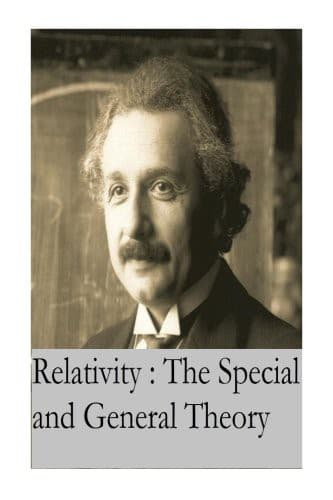
Relativity: The Special and General Theory — John Shaqi
Relativity: The Special and General TheoryEinstein, Albert
Science
Relativity: The Special and General Theory
Einstein, Albert
Relativity (Physics)
To what extent is the special theory of relativity supported by
experience? This question is not easily answered for the reason already
mentioned in connection with the fundamental experiment of Fizeau. The
special theory of relativity has crystallised out from the
Maxwell-Lorentz theory of electromagnetic phenomena. Thus all facts of
experience which support the electromagnetic theory also support the
theory of relativity. As being of particular importance, I mention here
the fact that the theory of relativity enables us to predict the
effects produced on the light reaching us from the fixed stars. These
results are obtained in an exceedingly simple manner, and the effects
indicated, which are due to the relative motion of the earth with
reference to those fixed stars are found to be in accord with
experience. We refer to the yearly movement of the apparent position of
the fixed stars resulting from the motion of the earth round the sun
(aberration), and to the influence of the radial components of the
relative motions of the fixed stars with respect to the earth on the
colour of the light reaching us from them. The latter effect manifests
itself in a slight displacement of the spectral lines of the light
transmitted to us from a fixed star, as compared with the position of
the same spectral lines when they are produced by a terrestrial source
of light (Doppler principle). The experimental arguments in favour of
the Maxwell-Lorentz theory, which are at the same time arguments in
favour of the theory of relativity, are too numerous to be set forth
here. In reality they limit the theoretical possibilities to such an
extent, that no other theory than that of Maxwell and Lorentz has been
able to hold its own when tested by experience.
But there are two classes of experimental facts hitherto obtained which
can be represented in the Maxwell-Lorentz theory only by the
introduction of an auxiliary hypothesis, which in itself—_i.e._ without
making use of the theory of relativity—appears extraneous.
It is known that cathode rays and the so-called β-rays emitted by
radioactive substances consist of negatively electrified particles
(electrons) of very small inertia and large velocity. By examining the
deflection of these rays under the influence of electric and magnetic
fields, we can study the law of motion of these particles very exactly.
Public-domain text, read in full here on John Shaqi.
Reviews
Reviews
No reviews yet
Be the first to share your thoughts on this work.
Join the Discussion
Join the discussion
Sign in to leave a comment or review.
Sign InorCreate an account