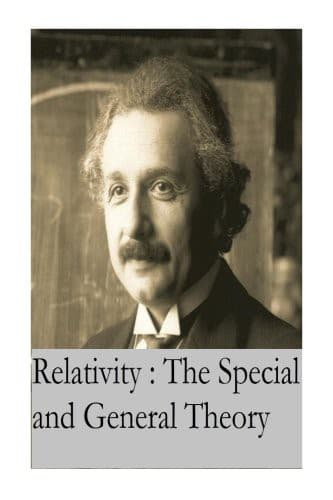
Relativity: The Special and General TheoryEinstein, Albert
Science
Relativity: The Special and General Theory
Einstein, Albert
Relativity (Physics)
In one of the most notable of these attempts Michelson devised a method
which appears as though it must be decisive. Imagine two mirrors so
arranged on a rigid body that the reflecting surfaces face each other.
A ray of light requires a perfectly definite time _T_ to pass from one
mirror to the other and back again, if the whole system be at rest with
respect to the æther. It is found by calculation, however, that a
slightly different time _T′_ is required for this process, if the body,
together with the mirrors, be moving relatively to the æther. And yet
another point: it is shown by calculation that for a given velocity _v_
with reference to the æther, this time _T′_ is different when the body
is moving perpendicularly to the planes of the mirrors from that
resulting when the motion is parallel to these planes. Although the
estimated difference between these two times is exceedingly small,
Michelson and Morley performed an experiment involving interference in
which this difference should have been clearly detectable. But the
experiment gave a negative result—a fact very perplexing to physicists.
Lorentz and FitzGerald rescued the theory from this difficulty by
assuming that the motion of the body relative to the æther produces a
contraction of the body in the direction of motion, the amount of
contraction being just sufficient to compensate for the difference in
time mentioned above. Comparison with the discussion in Section XII
shows that also from the standpoint of the theory of relativity this
solution of the difficulty was the right one. But on the basis of the
theory of relativity the method of interpretation is incomparably more
satisfactory. According to this theory there is no such thing as a
“specially favoured” (unique) co-ordinate system to occasion the
introduction of the æther-idea, and hence there can be no æther-drift,
nor any experiment with which to demonstrate it. Here the contraction
of moving bodies follows from the two fundamental principles of the
theory, without the introduction of particular hypotheses; and as the
prime factor involved in this contraction we find, not the motion in
itself, to which we cannot attach any meaning, but the motion with
respect to the body of reference chosen in the particular case in
point. Thus for a co-ordinate system moving with the earth the mirror
system of Michelson and Morley is not shortened, but it _is_ shortened
for a co-ordinate system which is at rest relatively to the sun.
XVII.
MINKOWSKI’S FOUR-DIMENSIONAL SPACE
The non-mathematician is seized by a mysterious shuddering when he
hears of “four-dimensional” things, by a feeling not unlike that
awakened by thoughts of the occult. And yet there is no more
common-place statement than that the world in which we live is a
four-dimensional space-time continuum.
Public-domain text, read in full here on John Shaqi.
Reviews
Reviews
No reviews yet
Be the first to share your thoughts on this work.
Join the Discussion
Join the discussion
Sign in to leave a comment or review.
Sign InorCreate an account