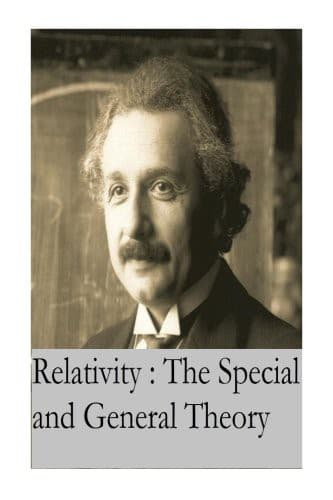
Relativity: The Special and General TheoryEinstein, Albert
Science
Relativity: The Special and General Theory
Einstein, Albert
Relativity (Physics)
“If we pick up a stone and then let it go, why does it fall to the
ground?” The usual answer to this question is: “Because it is attracted
by the earth.” Modern physics formulates the answer rather differently
for the following reason. As a result of the more careful study of
electromagnetic phenomena, we have come to regard action at a distance
as a process impossible without the intervention of some intermediary
medium. If, for instance, a magnet attracts a piece of iron, we cannot
be content to regard this as meaning that the magnet acts directly on
the iron through the intermediate empty space, but we are constrained
to imagine—after the manner of Faraday—that the magnet always calls
into being something physically real in the space around it, that
something being what we call a “magnetic field.” In its turn this
magnetic field operates on the piece of iron, so that the latter
strives to move towards the magnet. We shall not discuss here the
justification for this incidental conception, which is indeed a
somewhat arbitrary one. We shall only mention that with its aid
electromagnetic phenomena can be theoretically represented much more
satisfactorily than without it, and this applies particularly to the
transmission of electromagnetic waves. The effects of gravitation also
are regarded in an analogous manner.
The action of the earth on the stone takes place indirectly. The earth
produces in its surrounding a gravitational field, which acts on the
stone and produces its motion of fall. As we know from experience, the
intensity of the action on a body dimishes according to a quite
definite law, as we proceed farther and farther away from the earth.
From our point of view this means: The law governing the properties of
the gravitational field in space must be a perfectly definite one, in
order correctly to represent the diminution of gravitational action
with the distance from operative bodies. It is something like this: The
body (_e.g._ the earth) produces a field in its immediate neighbourhood
directly; the intensity and direction of the field at points farther
removed from the body are thence determined by the law which governs
the properties in space of the gravitational fields themselves.
In contrast to electric and magnetic fields, the gravitational field
exhibits a most remarkable property, which is of fundamental importance
for what follows. Bodies which are moving under the sole influence of a
gravitational field receive an acceleration, _which does not in the
least depend either on the material or on the physical state of the
body._ For instance, a piece of lead and a piece of wood fall in
exactly the same manner in a gravitational field (_in vacuo_), when
they start off from rest or with the same initial velocity. This law,
which holds most accurately, can be expressed in a different form in
the light of the following consideration.
According to Newton’s law of motion, we have
(Force) = (inertial mass) x (acceleration),
Public-domain text, read in full here on John Shaqi.
Reviews
Reviews
No reviews yet
Be the first to share your thoughts on this work.
Join the Discussion
Join the discussion
Sign in to leave a comment or review.
Sign InorCreate an account