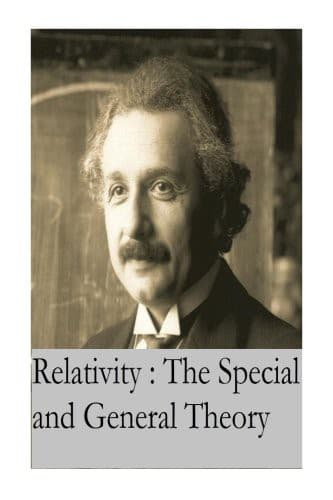
Relativity: The Special and General TheoryEinstein, Albert
Science
Relativity: The Special and General Theory
Einstein, Albert
Relativity (Physics)
In the second place our result shows that, according to the general
theory of relativity, the law of the constancy of the velocity of light
in vacuo, which constitutes one of the two fundamental assumptions in
the special theory of relativity and to which we have already
frequently referred, cannot claim any unlimited validity. A curvature
of rays of light can only take place when the velocity of propagation
of light varies with position. Now we might think that as a consequence
of this, the special theory of relativity and with it the whole theory
of relativity would be laid in the dust. But in reality this is not the
case. We can only conclude that the special theory of relativity cannot
claim an unlimited domain of validity; its results hold only so long as
we are able to disregard the influences of gravitational fields on the
phenomena (_e.g._ of light).
Since it has often been contended by opponents of the theory of
relativity that the special theory of relativity is overthrown by the
general theory of relativity, it is perhaps advisable to make the facts
of the case clearer by means of an appropriate comparison. Before the
development of electrodynamics the laws of electrostatics were looked
upon as the laws of electricity. At the present time we know that
electric fields can be derived correctly from electrostatic
considerations only for the case, which is never strictly realised, in
which the electrical masses are quite at rest relatively to each other,
and to the co-ordinate system. Should we be justified in saying that
for this reason electrostatics is overthrown by the field-equations of
Maxwell in electrodynamics? Not in the least. Electrostatics is
contained in electrodynamics as a limiting case; the laws of the latter
lead directly to those of the former for the case in which the fields
are invariable with regard to time. No fairer destiny could be allotted
to any physical theory, than that it should of itself point out the way
to the introduction of a more comprehensive theory, in which it lives
on as a limiting case.
In the example of the transmission of light just dealt with, we have
seen that the general theory of relativity enables us to derive
theoretically the influence of a gravitational field on the course of
natural processes, the laws of which are already known when a
gravitational field is absent. But the most attractive problem, to the
solution of which the general theory of relativity supplies the key,
concerns the investigation of the laws satisfied by the gravitational
field itself. Let us consider this for a moment.
Public-domain text, read in full here on John Shaqi.
Reviews
Reviews
No reviews yet
Be the first to share your thoughts on this work.
Join the Discussion
Join the discussion
Sign in to leave a comment or review.
Sign InorCreate an account