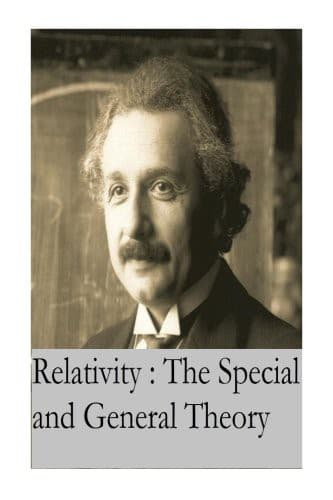
Relativity: The Special and General Theory — John Shaqi
Relativity: The Special and General TheoryEinstein, Albert
Science
Relativity: The Special and General Theory
Einstein, Albert
Relativity (Physics)
[20] Mathematicians have been confronted with our problem in the
following form. If we are given a surface (_e.g._ an ellipsoid) in
Euclidean three-dimensional space, then there exists for this surface
a two-dimensional geometry, just as much as for a plane surface. Gauss
undertook the task of treating this two-dimensional geometry from
first principles, without making use of the fact that the surface
belongs to a Euclidean continuum of three dimensions. If we imagine
constructions to be made with rigid rods _in the surface_ (similar to
that above with the marble slab), we should find that different laws
hold for these from those resulting on the basis of Euclidean plane
geometry. The surface is not a Euclidean continuum with respect to the
rods, and we cannot define Cartesian co-ordinates _in the surface_.
Gauss indicated the principles according to which we can treat the
geometrical relationships in the surface, and thus pointed out the way
to the method of Riemann of treating multi-dimensional, non-Euclidean
_continuum_. Thus it is that mathematicians long ago solved the formal
problems to which we are led by the general postulate of relativity.
XXV.
GAUSSIAN CO-ORDINATES
image033
According to Gauss, this combined analytical and geometrical mode of
handling the problem can be arrived at in the following way. We imagine
a system of arbitrary curves (see Fig. 4) drawn on the surface of the
table. These we designate as _u_-curves, and we indicate each of them
by means of a number. The Curves _u_ = 1, _u_ = 2 and _u_ = 3 are drawn
in the diagram. Between the curves _u_ = 1 and _u_ = 2 we must imagine
an infinitely large number to be drawn, all of which correspond to real
numbers lying between 1 and 2. We have then a system of _u_-curves, and
this “infinitely dense” system covers the whole surface of the table.
These _u_-curves must not intersect each other, and through each point
of the surface one and only one curve must pass. Thus a perfectly
definite value of _u_ belongs to every point on the surface of the
marble slab. In like manner we imagine a system of _v_-curves drawn on
the surface. These satisfy the same conditions as the _u_-curves, they
are provided with numbers in a corresponding manner, and they may
likewise be of arbitrary shape. It follows that a value of _u_ and a
value of _v_ belong to every point on the surface of the table. We call
these two numbers the co-ordinates of the surface of the table
(Gaussian co-ordinates). For example, the point _P_ in the diagram has
the Gaussian co-ordinates _u_ = 3, _v_ = 1. Two neighbouring points _P_
and _P′_ on the surface then correspond to the co-ordinates
_P_: _u, v_
_P′_: _u_ + _du, v_ + _dv_,
where _du_ and _dv_ signify very small numbers. In a similar manner we
may indicate the distance (line-interval) between _P_ and _P′_, as
measured with a little rod, by means of the very small number _ds_.
Then according to Gauss we have
Public-domain text, read in full here on John Shaqi.
Reviews
Reviews
No reviews yet
Be the first to share your thoughts on this work.
Join the Discussion
Join the discussion
Sign in to leave a comment or review.
Sign InorCreate an account