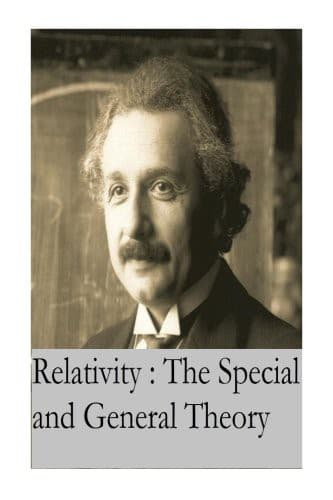
Relativity: The Special and General TheoryEinstein, Albert
Science
Relativity: The Special and General Theory
Einstein, Albert
Relativity (Physics)
Suppose we draw lines or stretch strings in all directions from a
point, and mark off from each of these the distance _r_ with a
measuring-rod. All the free end-points of these lengths lie on a
spherical surface. We can specially measure up the area (_F_) of this
surface by means of a square made up of measuring-rods. If the universe
is Euclidean, then _F_ = 4π_r_2; if it is spherical, then _F_ is always
less than 4π_r_2. With increasing values of _r, F_ increases from zero
up to a maximum value which is determined by the “world-radius,” but
for still further increasing values of _r_, the area gradually
diminishes to zero. At first, the straight lines which radiate from the
starting point diverge farther and farther from one another, but later
they approach each other, and finally they run together again at a
“counter-point” to the starting point. Under such conditions they have
traversed the whole spherical space. It is easily seen that the
three-dimensional spherical space is quite analogous to the
two-dimensional spherical surface. It is finite (_i.e._ of finite
volume), and has no bounds.
It may be mentioned that there is yet another kind of curved space:
“elliptical space.” It can be regarded as a curved space in which the
two “counter-points” are identical (indistinguishable from each other).
An elliptical universe can thus be considered to some extent as a
curved universe possessing central symmetry.
It follows from what has been said, that closed spaces without limits
are conceivable. From amongst these, the spherical space (and the
elliptical) excels in its simplicity, since all points on it are
equivalent. As a result of this discussion, a most interesting question
arises for astronomers and physicists, and that is whether the universe
in which we live is infinite, or whether it is finite in the manner of
the spherical universe. Our experience is far from being sufficient to
enable us to answer this question. But the general theory of relativity
permits of our answering it with a moderate degree of certainty, and in
this connection the difficulty mentioned in Section XXX finds its
solution.
XXXII.
THE STRUCTURE OF SPACE ACCORDING TO THE GENERAL THEORY OF RELATIVITY
According to the general theory of relativity, the geometrical
properties of space are not independent, but they are determined by
matter. Thus we can draw conclusions about the geometrical structure of
the universe only if we base our considerations on the state of the
matter as being something that is known. We know from experience that,
for a suitably chosen co-ordinate system, the velocities of the stars
are small as compared with the velocity of transmission of light. We
can thus as a rough approximation arrive at a conclusion as to the
nature of the universe as a whole, if we treat the matter as being at
rest.
Public-domain text, read in full here on John Shaqi.
Reviews
Reviews
No reviews yet
Be the first to share your thoughts on this work.
Join the Discussion
Join the discussion
Sign in to leave a comment or review.
Sign InorCreate an account