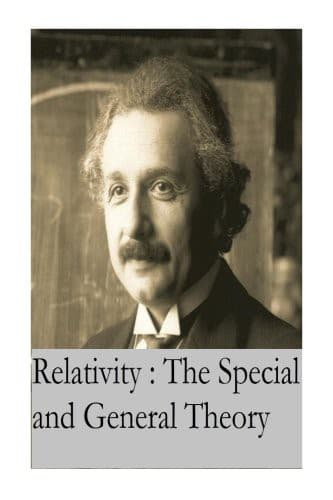
Relativity: The Special and General TheoryEinstein, Albert
Science
Relativity: The Special and General Theory
Einstein, Albert
Relativity (Physics)
Since the same light-signal has to be transmitted relative to _K′_ with
the velocity _c_, the propagation relative to the system _K′_ will be
represented by the analogous formula
_x′_ – _ct′_ = 0 . . . . . (2)
Those space-time points (events) which satisfy (1) must also satisfy
(2). Obviously this will be the case when the relation
(_x′_ – _ct′_) = λ(_x_ – _ct_) . . . (3).
is fulfilled in general, where λ indicates a constant; for, according
to (3), the disappearance of (_x_ – _ct_) involves the disappearance of
(_x′_ – _ct′_).
If we apply quite similar considerations to light rays which are being
transmitted along the negative _x_-axis, we obtain the condition
(_x′_ + _ct′_) = (_x + ct_) . . . (4).
By adding (or subtracting) equations (3) and (4), and introducing for
convenience the constants _a_ and _b_ in place of the constants λ and μ
where
image038
and
image039
we obtain the equations
image040
We should thus have the solution of our problem, if the constants _a_
and _b_ were known. These result from the following discussion.
For the origin of _K′_ we have permanently _x′_ = 0, and hence
according to the first of the equations (5)
image041
If we call _v_ the velocity with which the origin of _K′_ is moving
relative to _K_, we then have
image042
The same value _v_ can be obtained from equations (5), if we calculate
the velocity of another point of _K′_ relative to _K_, or the velocity
(directed towards the negative _x_-axis) of a point of _K_ with respect
to _K′_. In short, we can designate _v_ as the relative velocity of the
two systems.
Furthermore, the principle of relativity teaches us that, as judged
from K, the length of a unit measuring-rod which is at rest with
reference to _K′_ must be exactly the same as the length, as judged
from _K′_, of a unit measuring-rod which is at rest relative to _K_. In
order to see how the points of the _x′_-axis appear as viewed from _K_,
we only require to take a “snapshot” of _K′_ from _K_; this means that
we have to insert a particular value of _t_ (time of _K_), _e.g._ _t_ =
0. For this value of _t_ we then obtain from the first of the equations
(5)
_x′_ = _ax_
Two points of the _x′_-axis which are separated by the distance Δ_x′_ =
1 when measured in the _K′_ system are thus separated in our
instantaneous photograph by the distance
image043
But if the snapshot be taken from _K′_(_t′_ = 0), and if we eliminate
_t_ from the equations (5), taking into account the expression (6), we
obtain
image044
From this we conclude that two points on the _x_-axis separated by the
distance 1 (relative to _K_) will be represented on our snapshot by the
distance
image045
But from what has been said, the two snapshots must be identical; hence
Δ_x_ in (7) must be equal to Δ_x′_ in (7_a_), so that we obtain
image046
Public-domain text, read in full here on John Shaqi.
Reviews
Reviews
No reviews yet
Be the first to share your thoughts on this work.
Join the Discussion
Join the discussion
Sign in to leave a comment or review.
Sign InorCreate an account