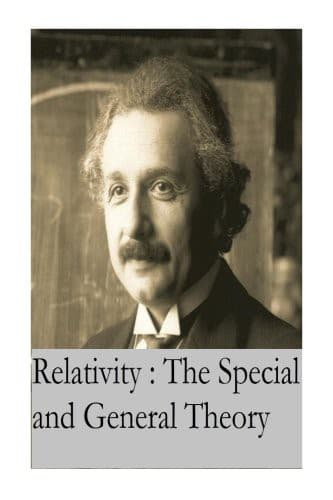
Relativity: The Special and General TheoryEinstein, Albert
Science
Relativity: The Special and General Theory
Einstein, Albert
Relativity (Physics)
But this point of view by no means embraces the whole of the actual
process; for it slurs over the important part played by intuition and
deductive thought in the development of an exact science. As soon as a
science has emerged from its initial stages, theoretical advances are
no longer achieved merely by a process of arrangement. Guided by
empirical data, the investigator rather develops a system of thought
which, in general, is built up logically from a small number of
fundamental assumptions, the so-called axioms. We call such a system of
thought a _theory_. The theory finds the justification for its
existence in the fact that it correlates a large number of single
observations, and it is just here that the “truth” of the theory lies.
Corresponding to the same complex of empirical data, there may be
several theories, which differ from one another to a considerable
extent. But as regards the deductions from the theories which are
capable of being tested, the agreement between the theories may be so
complete that it becomes difficult to find any deductions in which the
two theories differ from each other. As an example, a case of general
interest is available in the province of biology, in the Darwinian
theory of the development of species by selection in the struggle for
existence, and in the theory of development which is based on the
hypothesis of the hereditary transmission of acquired characters.
We have another instance of far-reaching agreement between the
deductions from two theories in Newtonian mechanics on the one hand,
and the general theory of relativity on the other. This agreement goes
so far, that up to the present we have been able to find only a few
deductions from the general theory of relativity which are capable of
investigation, and to which the physics of pre-relativity days does not
also lead, and this despite the profound difference in the fundamental
assumptions of the two theories. In what follows, we shall again
consider these important deductions, and we shall also discuss the
empirical evidence appertaining to them which has hitherto been
obtained.
(_a_) Motion of the Perihelion of Mercury
Public-domain text, read in full here on John Shaqi.
Reviews
Reviews
No reviews yet
Be the first to share your thoughts on this work.
Join the Discussion
Join the discussion
Sign in to leave a comment or review.
Sign InorCreate an account