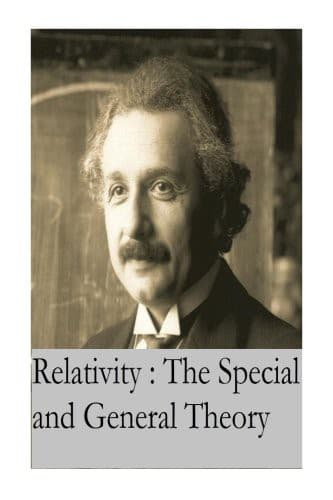
Relativity: The Special and General TheoryEinstein, Albert
Science
Relativity: The Special and General Theory
Einstein, Albert
Relativity (Physics)
We are indebted to the [British] Royal Society and to the Royal
Astronomical Society for the investigation of this important deduction.
Undaunted by the [first world] war and by difficulties of both a
material and a psychological nature aroused by the war, these societies
equipped two expeditions—to Sobral (Brazil), and to the island of
Principe (West Africa)—and sent several of Britain’s most celebrated
astronomers (Eddington, Cottingham, Crommelin, Davidson), in order to
obtain photographs of the solar eclipse of 29th May, 1919. The relative
discrepancies to be expected between the stellar photographs obtained
during the eclipse and the comparison photographs amounted to a few
hundredths of a millimetre only. Thus great accuracy was necessary in
making the adjustments required for the taking of the photographs, and
in their subsequent measurement.
The results of the measurements confirmed the theory in a thoroughly
satisfactory manner. The rectangular components of the observed and of
the calculated deviations of the stars (in seconds of arc) are set
forth in the following table of results:
image054
(_c_) Displacement of Spectral Lines Towards the Red
In Section XXIII it has been shown that in a system _K′_ which is in
rotation with regard to a Galileian system _K_, clocks of identical
construction, and which are considered at rest with respect to the
rotating reference-body, go at rates which are dependent on the
positions of the clocks. We shall now examine this dependence
quantitatively. A clock, which is situated at a distance r from the
centre of the disc, has a velocity relative to _K_ which is given by
_v_ = ω_r_,
where ω represents the angular velocity of rotation of the disc _K′_
with respect to _K_. If _v_0, represents the number of ticks of the
clock per unit time (“rate” of the clock) relative to _K_ when the
clock is at rest, then the “rate” of the clock (_v_) when it is moving
relative to _K_ with a velocity _v_, but at rest with respect to the
disc, will, in accordance with Section XII, be given by
image055
or with sufficient accuracy by
image056
This expression may also be stated in the following form:
image057
If we represent the difference of potential of the centrifugal force
between the position of the clock and the centre of the disc by φ,
_i.e._ the work, considered negatively, which must be performed on the
unit of mass against the centrifugal force in order to transport it
from the position of the clock on the rotating disc to the centre of
the disc, then we have
image058
From this it follows that
image059
In the first place, we see from this expression that two clocks of
identical construction will go at different rates when situated at
different distances from the centre of the disc. This result is also
valid from the standpoint of an observer who is rotating with the disc.
Public-domain text, read in full here on John Shaqi.
Reviews
Reviews
No reviews yet
Be the first to share your thoughts on this work.
Join the Discussion
Join the discussion
Sign in to leave a comment or review.
Sign InorCreate an account