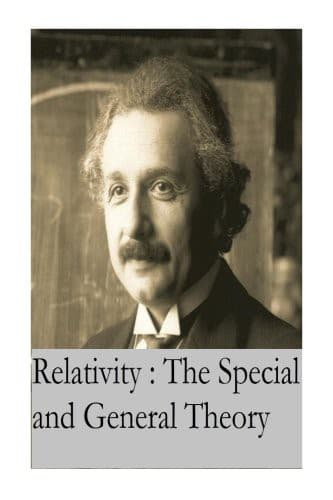
Relativity: The Special and General TheoryEinstein, Albert
Science
Relativity: The Special and General Theory
Einstein, Albert
Relativity (Physics)
It is not clear what is to be understood here by “position” and
“space.” I stand at the window of a railway carriage which is
travelling uniformly, and drop a stone on the embankment, without
throwing it. Then, disregarding the influence of the air resistance, I
see the stone descend in a straight line. A pedestrian who observes the
misdeed from the footpath notices that the stone falls to earth in a
parabolic curve. I now ask: Do the “positions” traversed by the stone
lie “in reality” on a straight line or on a parabola? Moreover, what is
meant here by motion “in space”? From the considerations of the
previous section the answer is self-evident. In the first place we
entirely shun the vague word “space,” of which, we must honestly
acknowledge, we cannot form the slightest conception, and we replace it
by “motion relative to a practically rigid body of reference.” The
positions relative to the body of reference (railway carriage or
embankment) have already been defined in detail in the preceding
section. If instead of “body of reference” we insert “system of
co-ordinates,” which is a useful idea for mathematical description, we
are in a position to say: The stone traverses a straight line relative
to a system of co-ordinates rigidly attached to the carriage, but
relative to a system of co-ordinates rigidly attached to the ground
(embankment) it describes a parabola. With the aid of this example it
is clearly seen that there is no such thing as an independently
existing trajectory (lit. “path-curve”[6], but only a trajectory
relative to a particular body of reference.
[6] That is, a curve along which the body moves.
In order to have a _complete_ description of the motion, we must
specify how the body alters its position _with time; i.e._ for every
point on the trajectory it must be stated at what time the body is
situated there. These data must be supplemented by such a definition of
time that, in virtue of this definition, these time-values can be
regarded essentially as magnitudes (results of measurements) capable of
observation. If we take our stand on the ground of classical mechanics,
we can satisfy this requirement for our illustration in the following
manner. We imagine two clocks of identical construction; the man at the
railway-carriage window is holding one of them, and the man on the
footpath the other. Each of the observers determines the position on
his own reference-body occupied by the stone at each tick of the clock
he is holding in his hand. In this connection we have not taken account
of the inaccuracy involved by the finiteness of the velocity of
propagation of light. With this and with a second difficulty prevailing
here we shall have to deal in detail later.
IV. THE GALILEIAN SYSTEM OF CO-ORDINATES
Public-domain text, read in full here on John Shaqi.
Reviews
Reviews
No reviews yet
Be the first to share your thoughts on this work.
Join the Discussion
Join the discussion
Sign in to leave a comment or review.
Sign InorCreate an account