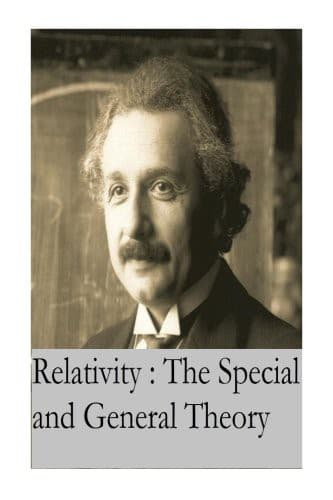
Relativity: The Special and General TheoryEinstein, Albert
Science
Relativity: The Special and General Theory
Einstein, Albert
Relativity (Physics)
At all events, a definite decision will be reached during the next few
years. If the displacement of spectral lines towards the red by the
gravitational potential does not exist, then the general theory of
relativity will be untenable. On the other hand, if the cause of the
displacement of spectral lines be definitely traced to the
gravitational potential, then the study of this displacement will
furnish us with important information as to the mass of the heavenly
bodies.[27]
[27] The displacement of spectral lines towards the red end of the
spectrum was definitely established by Adams in 1924, by observations
on the dense companion of Sirius, for which the effect is about thirty
times greater than for the Sun. R.W.L.—translator
APPENDIX IV
THE STRUCTURE OF SPACE ACCORDING TO THE GENERAL THEORY OF RELATIVITY
(SUPPLEMENTARY TO SECTION XXXII)
Since the publication of the first edition of this little book, our
knowledge about the structure of space in the large (“cosmological
problem”) has had an important development, which ought to be mentioned
even in a popular presentation of the subject.
My original considerations on the subject were based on two hypotheses:
(1) There exists an average density of matter in the whole of space
which is everywhere the same and different from zero.
(2) The magnitude (“radius”) of space is independent of time.
Both these hypotheses proved to be consistent, according to the general
theory of relativity, but only after a hypothetical term was added to
the field equations, a term which was not required by the theory as
such nor did it seem natural from a theoretical point of view
(“cosmological term of the field equations”).
Hypothesis (2) appeared unavoidable to me at the time, since I thought
that one would get into bottomless speculations if one departed from
it.
However, already in the ’twenties, the Russian mathematician Friedman
showed that a different hypothesis was natural from a purely
theoretical point of view. He realized that it was possible to preserve
hypothesis (1) without introducing the less natural cosmological term
into the field equations of gravitation, if one was ready to drop
hypothesis (2). Namely, the original field equations admit a solution
in which the “world radius” depends on time (expanding space). In that
sense one can say, according to Friedman, that the theory demands an
expansion of space.
A few years later Hubble showed, by a special investigation of the
extra-galactic nebulae (“milky ways”), that the spectral lines emitted
showed a red shift which increased regularly with the distance of the
nebulae. This can be interpreted in regard to our present knowledge
only in the sense of Doppler’s principle, as an expansive motion of the
system of stars in the large—as required, according to Friedman, by the
field equations of gravitation. Hubble’s discovery can, therefore, be
considered to some extent as a confirmation of the theory.
Public-domain text, read in full here on John Shaqi.
Reviews
Reviews
No reviews yet
Be the first to share your thoughts on this work.
Join the Discussion
Join the discussion
Sign in to leave a comment or review.
Sign InorCreate an account