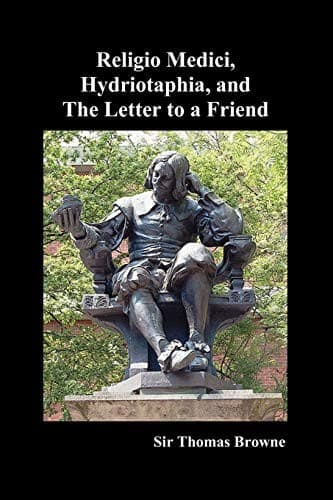
Religio Medici, Hydriotaphia, and the Letter to a FriendBrowne, Thomas, Sir
Religion
Religio Medici, Hydriotaphia, and the Letter to a Friend
Browne, Thomas, Sir
Christian ethics; Christian life; Essays; Funeral rites and ceremonies; Medical ethics; Medicine -- History; Religion and medicine
Men have lost their reason in nothing so much as their religion,
wherein stones and clouts make martyrs; and, since the religion of
one seems madness unto another, to afford an account or rational
of old rites requires no rigid reader. That they kindled the pyre
aversely, or turning their face from it, was an handsome symbol of
unwilling ministration. That they washed their bones with wine and
milk; that the mother wrapped them in linen, and dried them in her
bosom, the first fostering part and place of their nourishment; that
they opened their eyes toward heaven before they kindled the fire, as
the place of their hopes or original, were no improper ceremonies.
Their last valediction,[BL] thrice uttered by the attendants, was
also very solemn, and somewhat answered by Christians, who thought
it too little, if they threw not the earth thrice upon the interred
body. That, in strewing their tombs, the Romans affected the rose; the
Greeks amaranthus and myrtle: that the funeral pyre consisted of sweet
fuel, cypress, fir, larix, yew, and trees perpetually verdant, lay
silent expressions of their surviving hopes. Wherein Christians, who
deck their coffins with bays, have found a more elegant emblem; for
that it, seeming dead, will restore itself from the root, and its dry
and exsuccous leaves resume their verdure again; which, if we mistake
not, we have also observed in furze. Whether the planting of yew in
churchyards hold not its original from ancient funeral rites, or as
an emblem of resurrection, from its perpetual verdure, may also admit
conjecture.
[BL] “Vale, vale, nos te ordine quo natura permittet sequamur.”
They made use of musick to excite or quiet the affections of their
friends, according to different harmonies. But the secret and
symbolical hint was the harmonical nature of the soul; which, delivered
from the body, went again to enjoy the primitive harmony of heaven,
from whence it first descended; which, according to its progress traced
by antiquity, came down by Cancer, and ascended by Capricornus.
They burnt not children before their teeth appeared, as apprehending
their bodies too tender a morsel for fire, and that their gristly bones
would scarce leave separable relicks after the pyral combustion. That
they kindled not fire in their houses for some days after was a strict
memorial of the late afflicting fire. And mourning without hope, they
had an happy fraud against excessive lamentation, by a common opinion
that deep sorrows disturb their ghosts.[BM]
[BM] “Tu manes ne lœde meos.”
That they buried their dead on their backs, or in a supine position,
seems agreeable unto profound sleep, and common posture of dying;
contrary to the most natural way of birth; nor unlike our pendulous
posture, in the doubtful state of the womb. Diogenes was singular, who
preferred a prone situation in the grave; and some Christians[BN] like
neither, who decline the figure of rest, and make choice of an erect
posture.
[BN] The Russians, &c.
Public-domain text, read in full here on John Shaqi.
Reviews
Reviews
No reviews yet
Be the first to share your thoughts on this work.
Elsewhere in the archive
Join the Discussion
Join the discussion
Sign in to leave a comment or review.
Sign InorCreate an account