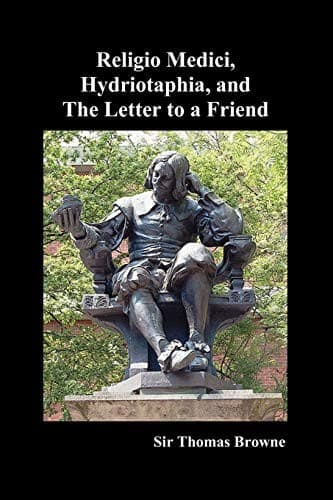
Religio Medici, Hydriotaphia, and the Letter to a FriendBrowne, Thomas, Sir
Religion
Religio Medici, Hydriotaphia, and the Letter to a Friend
Browne, Thomas, Sir
Christian ethics; Christian life; Essays; Funeral rites and ceremonies; Medical ethics; Medicine -- History; Religion and medicine
To subsist in lasting monuments, to live in their productions, to exist
in their names and predicament of chimeras, was large satisfaction unto
old expectations, and made one part of their Elysiums. But all this is
nothing in the metaphysicks of true belief. To live indeed, is to be
again ourselves, which being not only an hope, but an evidence in noble
believers, ’tis all one to lie in St Innocent’s[BZ] church-yard as in
the sands of Egypt. Ready to be anything, in the ecstasy of being ever,
and as content with six foot as the _moles_ of Adrianus.[CA]
[BZ] In Paris, where bodies soon consume.
[CA] A stately mausoleum or sepulchral pile, built by Adrianus in Rome,
where now standeth the castle of St Angelo.
----“_Tabésne cadavera solvat,
An rogus, haud refert._”--LUCAN. viii. 809.
A LETTER TO A FRIEND,
UPON OCCASION OF THE DEATH OF HIS INTIMATE FRIEND.
LETTER TO A FRIEND.
GIVE me leave to wonder that news of this nature should have such heavy
wings that you should hear so little concerning your dearest friend,
and that I must make that unwilling repetition to tell you “_ad portam
rigidos calces extendit_,” that he is dead and buried, and by this time
no puny among the mighty nations of the dead; for though he left this
world not very many days past, yet every hour you know largely addeth
unto that dark society; and considering the incessant mortality of
mankind, you cannot conceive there dieth in the whole earth so few as a
thousand an hour.
Although at this distance you had no early account or particular of his
death, yet your affection may cease to wonder that you had not some
secret sense or intimation thereof by dreams, thoughtful whisperings,
mercurisms, airy nuncios or sympathetical insinuations, which many
seem to have had at the death of their dearest friends: for since
we find in that famous story, that spirits themselves were fain to
tell their fellows at a distance that the great Antonio was dead, we
have a sufficient excuse for our ignorance in such particulars, and
must rest content with the common road, and Appian way of knowledge
by information. Though the uncertainty of the end of this world hath
confounded all human predictions; yet they who shall live to see the
sun and moon darkened, and the stars to fall from heaven, will hardly
be deceived in the advent of the last day; and therefore strange
it is, that the common fallacy of consumptive persons who feel not
themselves dying, and therefore still hope to live, should also reach
their friends in perfect health and judgment;--that you should be so
little acquainted with Plautus’s sick complexion, or that almost an
Hippocratical face should not alarum you to higher fears, or rather
despair, of his continuation in such an emaciated state, wherein
medical predictions fail not, as sometimes in acute diseases, and
wherein ’tis as dangerous to be sentenced by a physician as a judge.
Public-domain text, read in full here on John Shaqi.
Reviews
Reviews
No reviews yet
Be the first to share your thoughts on this work.
Elsewhere in the archive
Join the Discussion
Join the discussion
Sign in to leave a comment or review.
Sign InorCreate an account