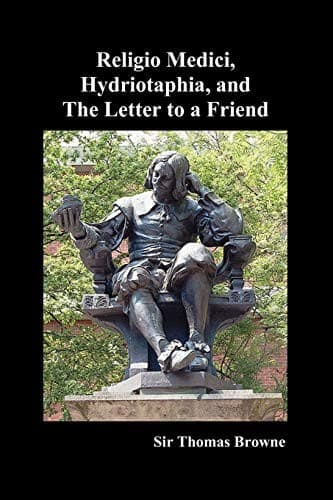
Religio Medici, Hydriotaphia, and the Letter to a FriendBrowne, Thomas, Sir
Religion
Religio Medici, Hydriotaphia, and the Letter to a Friend
Browne, Thomas, Sir
Christian ethics; Christian life; Essays; Funeral rites and ceremonies; Medical ethics; Medicine -- History; Religion and medicine
I was not so curious to entitle the stars unto any concern of his
death, yet could not but take notice that he died when the moon was in
motion from the meridian; at which time an old Italian long ago would
persuade me that the greatest part of men died: but herein I confess
I could never satisfy my curiosity; although from the time of tides
in places upon or near the sea, there may be considerable deductions;
and Pliny[CG] hath an odd and remarkable passage concerning the death
of men and animals upon the recess or ebb of the sea. However, certain
it is, he died in the dead and deep part of the night, when Nox might
be most apprehensibly said to be the daughter of Chaos, the mother of
sleep and death, according to old genealogy; and so went out of this
world about that hour when our blessed Saviour entered it, and about
what time many conceive he will return again unto it. Cardan[112] hath
a peculiar and no hard observation from a man’s hand to know whether he
was born in the day or night, which I confess holdeth in my own. And
Scaliger[113] to that purpose hath another from the tip of the ear:[CH]
most men are begotten in the night, animals in the day; but whether
more persons have been born in the night or day, were a curiosity
undecidable, though more have perished by violent deaths in the day;
yet in natural dissolutions both times may hold an indifferency, at
least but contingent inequality. The whole course of time runs out
in the nativity and death of things; which whether they happen by
succession or coincidence, are best computed by the natural, not
artificial day.
[CG] “Aristoteles nullum animal nisi æstu recedente expirare affirmat;
observatum id multum in Gallico Oceano et duntaxat in homine
compertum,” lib. 2, cap. 101.
[CH] “Auris pars pendula lobus dicitur, non omnibus ea pars, est
auribus; non enim iis qui noctu sunt, sed qui interdiu, maxima ex
parte.”--_Com. in Aristot. de Animal._ lib. 1.
Public-domain text, read in full here on John Shaqi.
Reviews
Reviews
No reviews yet
Be the first to share your thoughts on this work.
Elsewhere in the archive
Join the Discussion
Join the discussion
Sign in to leave a comment or review.
Sign InorCreate an account