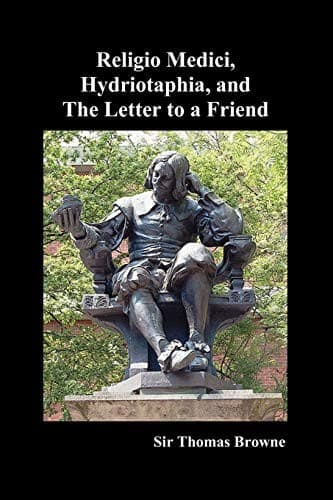
Religio Medici, Hydriotaphia, and the Letter to a FriendBrowne, Thomas, Sir
Religion
Religio Medici, Hydriotaphia, and the Letter to a Friend
Browne, Thomas, Sir
Christian ethics; Christian life; Essays; Funeral rites and ceremonies; Medical ethics; Medicine -- History; Religion and medicine
That Charles the Fifth[114] was crowned upon the day of his nativity,
it being in his own power so to order it, makes no singular
animadversion: but that he should also take King Francis[115] prisoner
upon that day, was an unexpected coincidence, which made the same
remarkable. Antipater, who had an anniversary feast every year upon
his birth-day, needed no astrological revolution to know what day he
should die on. When the fixed stars have made a revolution unto the
points from whence they first set out, some of the ancients thought
the world would have an end; which was a kind of dying upon the day of
its nativity. Now the disease prevailing and swiftly advancing about
the time of his nativity, some were of opinion that he would leave
the world on the day he entered into it; but this being a lingering
disease, and creeping softly on, nothing critical was found or
expected, and he died not before fifteen days after. Nothing is more
common with infants than to die on the day of their nativity, to behold
the worldly hours, and but the fractions thereof; and even to perish
before their nativity in the hidden world of the womb, and before
their good angel is conceived to undertake them. But in persons who
outlive many years, and when there are no less than three hundred and
sixty-five days to determine their lives in every year; that the first
day should make the last, that the tail of the snake should return into
its mouth precisely at that time, and they should wind up upon the day
of their nativity, is indeed a remarkable coincidence, which, though
astrology hath taken witty pains to salve, yet hath it been very wary
in making predictions of it.[CI]
[CI] According to the Egyptian hieroglyphic.
In this consumptive condition and remarkable extenuation, he came to
be almost half himself, and left a great part behind him, which he
carried not to the grave. And though that story of Duke John Ernestus
Mansfield[116][CJ] be not so easily swallowed, that at his death his
heart was found not to be so big as a nut; yet if the bones of a good
skeleton weigh little more than twenty pounds, his inwards and flesh
remaining could make no bouffage,[117] but a light bit for the grave.
I never more lively beheld the starved characters of Dante[CK] in any
living face; an _aruspex_ might have read a lecture upon him without
exenteration, his flesh being so consumed, that he might, in a manner,
have discerned his bowels without opening of him; so that to be
carried, _sexta cervice_[CL] to the grave, was but a civil unnecessity;
and the complements of the coffin might outweigh the subject of it.
[CJ] Turkish history.
[CK] In the poet Dante’s description.
[CL] i.e. “by six persons.”
Public-domain text, read in full here on John Shaqi.
Reviews
Reviews
No reviews yet
Be the first to share your thoughts on this work.
Elsewhere in the archive
Join the Discussion
Join the discussion
Sign in to leave a comment or review.
Sign InorCreate an account