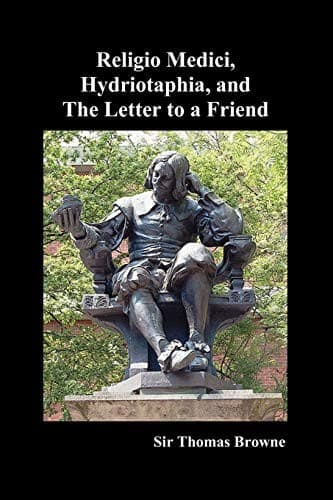
Religio Medici, Hydriotaphia, and the Letter to a FriendBrowne, Thomas, Sir
Religion
Religio Medici, Hydriotaphia, and the Letter to a Friend
Browne, Thomas, Sir
Christian ethics; Christian life; Essays; Funeral rites and ceremonies; Medical ethics; Medicine -- History; Religion and medicine
_Omnibonus Ferrarius_ in mortal dysenteries of children looks for a
spot behind the ear; in consumptive diseases some eye the complexion of
moles; Cardan eagerly views the nails, some the lines of the hand, the
thenar or muscle of the thumb; some are so curious as to observe the
depth of the throat-pit, how the proportion varieth of the small of the
legs unto the calf, or the compass of the neck unto the circumference
of the head; but all these, with many more, were so drowned in a
mortal visage, and last face of Hippocrates, that a weak physiognomist
might say at first eye, this was a face of earth, and that _Morta_[CM]
had set her hard seal upon his temples, easily perceiving what
_caricatura_[CN] draughts death makes upon pined faces, and unto what
an unknown degree a man may live backward.
[CM] Morta, the deity of death or fate.
[CN] When men’s faces are drawn with resemblance to some other animals,
the Italians call it, to be drawn _in caricatura_.
Though the beard be only made a distinction of sex, and sign of
masculine heat by _Ulmus_,[CO] yet the precocity and early growth
thereof in him, was not to be liked in reference unto long life.
Lewis, that virtuous but unfortunate king of Hungary, who lost his
life at the battle of Mohacz,[118] was said to be born without a skin,
to have bearded at fifteen, and to have shown some grey hairs about
twenty; from whence the diviners conjectured that he would be spoiled
of his kingdom, and have but a short life; but hairs make fallible
predictions, and many temples early grey have outlived the psalmist’s
period.[CP] Hairs which have most amused me have not been in the face
or head, but on the back, and not in men but children, as I long ago
observed in that endemial distemper of children in Languedoc, called
the _morgellons_,[CQ] wherein they critically break out with harsh
hairs on their backs, which takes off the unquiet symptoms of the
disease, and delivers them from coughs and convulsions.
[CO] _Ulmus de usu barbæ humanæ._
[CP] The life of man is threescore and ten.
[CQ] See _Picotus de Rheumatismo_.
The Egyptian mummies that I have seen, have had their mouths open, and
somewhat gaping, which affordeth a good opportunity to view and observe
their teeth, wherein ’tis not easy to find any wanting or decayed; and
therefore in Egypt, where one man practised but one operation, or the
diseases but of single parts, it must needs be a barren profession to
confine unto that of drawing of teeth, and to have been little better
than tooth-drawer unto King Pyrrhus,[CR] who had but two in his head.
[CR] His upper jaw being solid, and without distinct rows of teeth.
Public-domain text, read in full here on John Shaqi.
Reviews
Reviews
No reviews yet
Be the first to share your thoughts on this work.
Elsewhere in the archive
Join the Discussion
Join the discussion
Sign in to leave a comment or review.
Sign InorCreate an account