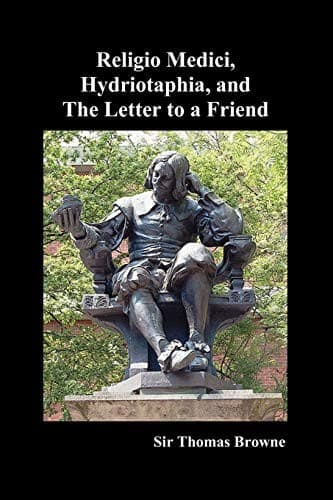
Religio Medici, Hydriotaphia, and the Letter to a FriendBrowne, Thomas, Sir
Religion
Religio Medici, Hydriotaphia, and the Letter to a Friend
Browne, Thomas, Sir
Christian ethics; Christian life; Essays; Funeral rites and ceremonies; Medical ethics; Medicine -- History; Religion and medicine
He was willing to quit the world alone and altogether, leaving no
earnest behind him for corruption or after-grave, having small content
in that common satisfaction to survive or live in another, but amply
satisfied that his disease should die with himself, nor revive in a
posterity to puzzle physic, and make sad mementoes of their parent
hereditary. Leprosy awakes not sometimes before forty, the gout and
stone often later; but consumptive and tabid[CX] roots sprout more
early, and at the fairest make seventeen years of our life doubtful
before that age. They that enter the world with original diseases as
well as sin, have not only common mortality but sick traductions to
destroy them, make commonly short courses, and live not at length
but in figures; so that a sound Cæsarean nativity[CY] may outlast a
natural birth, and a knife may sometimes make way for a more lasting
fruit than a midwife; which makes so few infants now able to endure the
old test of the river,[CZ] and many to have feeble children who could
scarce have been married at Sparta, and those provident states who
studied strong and healthful generations; which happen but contingently
in mere pecuniary matches or marriages made by the candle, wherein
notwithstanding there is little redress to be hoped from an astrologer
or a lawyer, and a good discerning physician were like to prove the
most successful counsellor.
[CX] Tabes maxime contingunt ab anno decimo octavo and trigesi mum
quintum.--_Hippoc._
[CY] A sound child cut out of the body of the mother.
[CZ] Natos ad flumina primum deferimus sævoque gelu dura mus et undis.
Julius Scaliger, who in a sleepless fit of the gout could make two
hundred verses in a night, would have but five[DA] plain words upon his
tomb. And this serious person, though no minor wit, left the poetry of
his epitaph unto others; either unwilling to commend himself, or to be
judged by a distich, and perhaps considering how unhappy great poets
have been in versifying their own epitaphs; wherein Petrarch, Dante,
and Ariosto, have so unhappily failed, that if their tombs should
outlast their works, posterity would find so little of Apollo on them
as to mistake them for Ciceronian poets.
[DA] Julii Cæsaris Scaligeri quod fuit.--_Joseph. Scaliger in vita
patris._
Public-domain text, read in full here on John Shaqi.
Reviews
Reviews
No reviews yet
Be the first to share your thoughts on this work.
Elsewhere in the archive
Join the Discussion
Join the discussion
Sign in to leave a comment or review.
Sign InorCreate an account