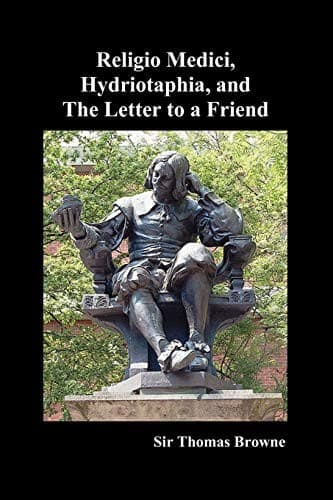
Religio Medici, Hydriotaphia, and the Letter to a FriendBrowne, Thomas, Sir
Religion
Religio Medici, Hydriotaphia, and the Letter to a Friend
Browne, Thomas, Sir
Christian ethics; Christian life; Essays; Funeral rites and ceremonies; Medical ethics; Medicine -- History; Religion and medicine
His willingness to leave this world about that age, when most men think
they may best enjoy it, though paradoxical unto worldly ears, was
not strange unto mine, who have so often observed, that many, though
old, oft stick fast unto the world, and seem to be drawn like Cacus’s
oxen[121], backward, with great struggling and reluctancy unto the
grave. The long habit of living makes mere men more hardly to part with
life, and all to be nothing, but what is to come. To live at the rate
of the old world, when some could scarce remember themselves young,
may afford no better digested death than a more moderate period. Many
would have thought it an happiness to have had their lot of life in
some notable conjunctures of ages past; but the uncertainty of future
times have tempted few to make a part in ages to come. And surely, he
that hath taken the true altitude of things, and rightly calculated the
degenerate state of this age, is not like to envy those that shall live
in the next, much less three or four hundred years hence, when no man
can comfortably imagine what face this world will carry: and therefore
since every age makes a step unto the end of all things, and the
Scripture affords so hard a character of the last times; quiet minds
will be content with their generations, and rather bless ages past,
than be ambitious of those to come.
Though age had set no seal upon his face, yet a dim eye might clearly
discover fifty in his actions; and therefore, since wisdom is the grey
hair, and an unspotted life old age; although his years come short,
he might have been said to have held up with longer livers, and to
have been Solomon’s[DE] old man. And surely if we deduct all those
days of our life which we might wish unlived, and which abate the
comfort of those we now live; if we reckon up only those days which
God hath accepted of our lives, a life of good years will hardly be a
span long: the son in this sense may outlive the father, and none be
climacterically old. He that early arriveth unto the parts and prudence
of age, is happily old without the uncomfortable attendants of it; and
’tis superfluous to live unto grey hairs, when in precocious temper we
anticipate the virtues of them. In brief, he cannot be accounted young
who outliveth the old man. He that hath early arrived unto the measure
of a perfect stature in Christ, hath already fulfilled the prime and
longest intention of his being; and one day lived after the perfect
rule of piety, is to be preferred before sinning immortality.
[DE] Wisdom, cap. iv.
Although he attained not unto the years of his predecessors, yet he
wanted not those preserving virtues which confirm the thread of weaker
constitutions. _Cautelous_ chastity and _crafty_ sobriety were far from
him; those jewels were _paragon_, without flaw, hair, ice, or cloud in
him; which affords me a hint to proceed in these good wishes, and few
mementoes unto you.
Public-domain text, read in full here on John Shaqi.
Reviews
Reviews
No reviews yet
Be the first to share your thoughts on this work.
Elsewhere in the archive
Join the Discussion
Join the discussion
Sign in to leave a comment or review.
Sign InorCreate an account