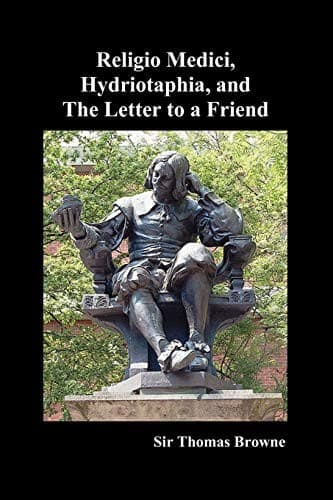
Religio Medici, Hydriotaphia, and the Letter to a FriendBrowne, Thomas, Sir
Religion
Religio Medici, Hydriotaphia, and the Letter to a Friend
Browne, Thomas, Sir
Christian ethics; Christian life; Essays; Funeral rites and ceremonies; Medical ethics; Medicine -- History; Religion and medicine
Not to fear death,[DB] nor desire it, was short of his resolution: to
be dissolved, and be with Christ, was his dying ditty. He conceived
his thread long, in no long course of years, and when he had scarce
outlived the second life of Lazarus;[DC] esteeming it enough to
approach the years of his Saviour, who so ordered his own human state,
as not to be old upon earth.
[DB] Summum nec metuas diem nec optes.
[DC] Who upon some accounts, and tradition, is said to have lived
thirty years after he was raised by our Saviour.--_Baronius._
But to be content with death may be better than to desire it; a
miserable life may make us wish for death, but a virtuous one to rest
in it; which is the advantage of those resolved Christians, who looking
on death not only as the sting, but the period and end of sin, the
horizon and isthmus between this life and a better, and the death of
this world but as a nativity of another, do contentedly submit unto the
common necessity, and envy not Enoch or Elias.
Not to be content with life is the unsatisfactory state of those who
destroy themselves,[DD] who being afraid to live run blindly upon
their own death, which no man fears by experience: and the Stoics had
a notable doctrine to take away the fear thereof; that is, in such
extremities, to desire that which is not to be avoided, and wish what
might be feared; and so made evils voluntary, and to suit with their
own desires, which took off the terror of them.
[DD] In the speech of Vulteius in Lucan, animating his soldiers in a
great struggle to kill one another.--“Decernite letum, et metus omnis
abest, cupias quodcumque necesse est.” “All fear is over, do but
resolve to die, and make your desires meet necessity.”--_Phars._ iv.
486.
But the ancient martyrs were not encouraged by such fallacies; who,
though they feared not death, were afraid to be their own executioners;
and therefore thought it more wisdom to crucify their lusts than their
bodies, to circumcise than stab their hearts, and to mortify than kill
themselves.
Public-domain text, read in full here on John Shaqi.
Reviews
Reviews
No reviews yet
Be the first to share your thoughts on this work.
Elsewhere in the archive
Join the Discussion
Join the discussion
Sign in to leave a comment or review.
Sign InorCreate an account