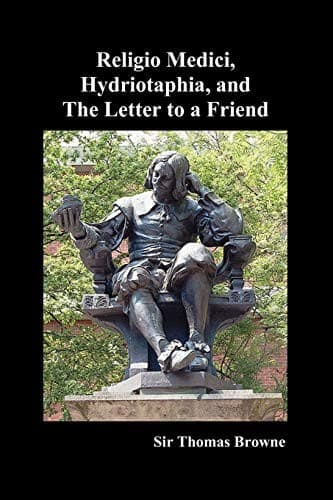
Religio Medici, Hydriotaphia, and the Letter to a FriendBrowne, Thomas, Sir
Religion
Religio Medici, Hydriotaphia, and the Letter to a Friend
Browne, Thomas, Sir
Christian ethics; Christian life; Essays; Funeral rites and ceremonies; Medical ethics; Medicine -- History; Religion and medicine
_Sect._ 13.--That other attribute, wherewith I recreate my devotion, is
his wisdom, in which I am happy; and for the contemplation of this only
do not repent me that I was bred in the way of study. The advantage I
have therein, is an ample recompense for all my endeavours, in what
part of knowledge soever. Wisdom is his most beauteous attribute:
no man can attain unto it: yet Solomon pleased God when he desired
it. He is wise, because he knows all things; and he knoweth all
things, because he made them all: but his greatest knowledge is in
comprehending that he made not, that is, himself. And this is also the
greatest knowledge in man. For this do I honour my own profession,
and embrace the counsel even of the devil himself: had he read such a
lecture in Paradise as he did at Delphos,[D][13] we had better known
ourselves; nor had we stood in fear to know him. I know God is wise in
all; wonderful in what we conceive, but far more in what we comprehend
not: for we behold him but asquint, upon reflex or shadow; our
understanding is dimmer than Moses’s eye; we are ignorant of the back
parts or lower side of his divinity; therefore, to pry into the maze of
his counsels, is not only folly in man, but presumption even in angels.
Like us, they are his servants, not his senators; he holds no counsel,
but that mystical one of the Trinity, wherein, though there be three
persons, there is but one mind that decrees without contradiction.
Nor needs he any; his actions are not begot with deliberation; his
wisdom naturally knows what’s best: his intellect stands ready fraught
with the superlative and purest ideas of goodness, consultations,
and election, which are two motions in us, make but one in him: his
actions springing from his power at the first touch of his will. These
are contemplations metaphysical: my humble speculations have another
method, and are content to trace and discover those expressions he hath
left in his creatures, and the obvious effects of nature. There is
no danger to profound[14] these mysteries, no _sanctum sanctorum_ in
philosophy. The world was made to be inhabited by beasts, but studied
and contemplated by man: ’tis the debt of our reason we owe unto God,
and the homage we pay for not being beasts. Without this, the world is
still as though it had not been, or as it was before the sixth day,
when as yet there was not a creature that could conceive or say there
was a world. The wisdom of God receives small honour from those vulgar
heads that rudely stare about, and with a gross rusticity admire his
works. Those highly magnify him, whose judicious enquiry into his acts,
and deliberate research into his creatures, return the duty of a devout
and learned admiration. Therefore,
[D] “Γνῶθι σεαυτὸν.” “Nosce teipsum.”
Public-domain text, read in full here on John Shaqi.
Reviews
Reviews
No reviews yet
Be the first to share your thoughts on this work.
Join the Discussion
Join the discussion
Sign in to leave a comment or review.
Sign InorCreate an account