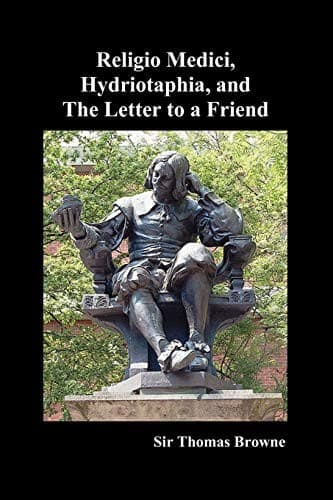
Religio Medici, Hydriotaphia, and the Letter to a FriendBrowne, Thomas, Sir
Religion
Religio Medici, Hydriotaphia, and the Letter to a Friend
Browne, Thomas, Sir
Christian ethics; Christian life; Essays; Funeral rites and ceremonies; Medical ethics; Medicine -- History; Religion and medicine
_Sect._ 16.--Thus there are two books from whence I collect my
divinity. Besides that written one of God, another of his servant,
nature, that universal and publick manuscript, that lies expansed unto
the eyes of all. Those that never saw him in the one have discovered
him in the other; this was the scripture and theology of the heathens;
the natural motion of the sun made them more admire him than its
supernatural station did the children of Israel. The ordinary effects
of nature wrought more admiration in them than, in the other, all
his miracles. Surely the heathens knew better how to join and read
these mystical letters than we Christians, who cast a more careless
eye on these common hieroglyphics, and disdain to suck divinity from
the flowers of nature. Nor do I so forget God as to adore the name of
nature; which I define not, with the schools, to be the principle of
motion and rest, but that straight and regular line, that settled and
constant course the wisdom of God hath ordained the actions of his
creatures, according to their several kinds. To make a revolution every
day is the nature of the sun, because of that necessary course which
God hath ordained it, from which it cannot swerve but by a faculty from
that voice which first did give it motion. Now this course of nature
God seldom alters or perverts; but, like an excellent artist, hath so
contrived his work, that, with the self-same instrument, without a
new creation, he may effect his obscurest designs. Thus he sweeteneth
the water with a word, preserveth the creatures in the ark, which the
blest of his mouth might have as easily created;--for God is like a
skilful geometrician, who, when more easily, and with one stroke of
his compass, he might describe or divide a right line, had yet rather
do this in a circle or longer way, according to the constituted and
forelaid principles of his art: yet this rule of his he doth sometimes
pervert, to acquaint the world with his prerogative, lest the arrogancy
of our reason should question his power, and conclude he could not.
And thus I call the effects of nature the works of God, whose hand and
instrument she only is; and therefore, to ascribe his actions unto her
is to devolve the honour of the principal agent upon the instrument;
which if with reason we may do, then let our hammers rise up and boast
they have built our houses, and our pens receive the honour of our
writing. I hold there is a general beauty in the works of God, and
therefore no deformity in any kind of species of creature whatsoever.
I cannot tell by what logick we call a toad, a bear, or an elephant
ugly; they being created in those outward shapes and figures which
best express the actions of their inward forms; and having passed that
general visitation of God, who saw that all that he had made was good,
that is, conformable to his will, which abhors deformity, and is the
rule of order and beauty. There is no deformity but in monstrosity;
Public-domain text, read in full here on John Shaqi.
Religio Medici, Hydriotaphia, and the Letter to a Friend — John Shaqi
Reviews
Reviews
No reviews yet
Be the first to share your thoughts on this work.
Join the Discussion
Join the discussion
Sign in to leave a comment or review.
Sign InorCreate an account