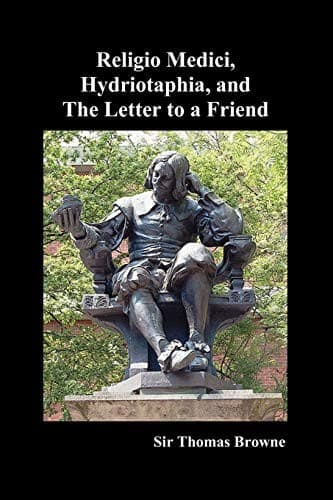
Religio Medici, Hydriotaphia, and the Letter to a FriendBrowne, Thomas, Sir
Religion
Religio Medici, Hydriotaphia, and the Letter to a Friend
Browne, Thomas, Sir
Christian ethics; Christian life; Essays; Funeral rites and ceremonies; Medical ethics; Medicine -- History; Religion and medicine
_Sect._ 27.--That miracles are ceased, I can neither prove nor
absolutely deny, much less define the time and period of their
cessation. That they survived Christ is manifest upon record of
Scripture: that they outlived the apostles also, and were revived at
the conversion of nations, many years after, we cannot deny, if we
shall not question those writers whose testimonies we do not controvert
in points that make for our own opinions: therefore, that may have
some truth in it, that is reported by the Jesuits of their miracles
in the Indies. I could wish it were true, or had any other testimony
than their own pens. They may easily believe those miracles abroad, who
daily conceive a greater at home--the transmutation of those visible
elements into the body and blood of our Saviour;--for the conversion
of water into wine, which he wrought in Cana, or, what the devil would
have had him done in the wilderness, of stones into bread, compared
to this, will scarce deserve the name of a miracle: though, indeed,
to speak properly, there is not one miracle greater than another;
they being the extraordinary effects of the hand of God, to which all
things are of an equal facility; and to create the world as easy as
one single creature. For this is also a miracle; not only to produce
effects against or above nature, but before nature; and to create
nature, as great a miracle as to contradict or transcend her. We do too
narrowly define the power of God, restraining it to our capacities. I
hold that God can do all things: how he should work contradictions,
I do not understand, yet dare not, therefore, deny. I cannot see why
the angel of God should question Esdras to recall the time past, if
it were beyond his own power; or that God should pose mortality in
that which he was not able to perform himself. I will not say that God
cannot, but he will not, perform many things, which we plainly affirm
he cannot. This, I am sure, is the mannerliest proposition; wherein,
notwithstanding, I hold no paradox: for, strictly, his power is the
same with his will; and they both, with all the rest, do make but one
God.
Public-domain text, read in full here on John Shaqi.
Reviews
Reviews
No reviews yet
Be the first to share your thoughts on this work.
Join the Discussion
Join the discussion
Sign in to leave a comment or review.
Sign InorCreate an account