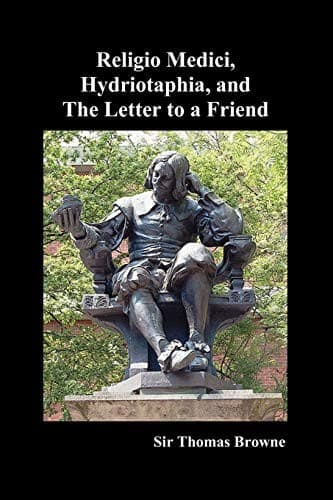
Religio Medici, Hydriotaphia, and the Letter to a FriendBrowne, Thomas, Sir
Religion
Religio Medici, Hydriotaphia, and the Letter to a Friend
Browne, Thomas, Sir
Christian ethics; Christian life; Essays; Funeral rites and ceremonies; Medical ethics; Medicine -- History; Religion and medicine
conjunction with the devil, is ridiculous, and a conceit fitter for a
rabbin than a Christian. I hold that the devil doth really possess some
men; the spirit of melancholy others; the spirit of delusion others:
that, as the devil is concealed and denied by some, so God and good
angels are pretended by others, whereof the late defection of the maid
of Germany hath left a pregnant example.[47]
_Sect._ 31.--Again, I believe that all that use sorceries,
incantations, and spells, are not witches, or, as we term them,
magicians. I conceive there is a traditional magick, not learned
immediately from the devil, but at second hand from his scholars, who,
having once the secret betrayed, are able and do empirically practise
without his advice; they both proceeding upon the principles of nature;
where actives, aptly conjoined to disposed passives, will, under any
master, produce their effects. Thus, I think, at first, a great part
of philosophy was witchcraft; which, being afterward derived to one
another, proved but philosophy, and was indeed no more than the honest
effects of nature:--what invented by us, is philosophy; learned from
him, is magick. We do surely owe the discovery of many secrets to the
discovery of good and bad angels. I could never pass that sentence
of Paracelsus without an asterisk, or annotation: “_ascendens[I]
constellatum multa revelat quærentibus magnalia naturæ_, i.e. _opera
Dei_.” I do think that many mysteries ascribed to our own inventions
have been the corteous revelations of spirits; for those noble essences
in heaven bear a friendly regard unto their fellow-nature on earth; and
therefore believe that those many prodigies and ominous prognosticks,
which forerun the ruins of states, princes, and private persons,
are the charitable premonitions of good angels, which more careless
inquiries term but the effects of chance and nature.
[I] Thereby is meant our good angel, appointed us from our nativity.
Public-domain text, read in full here on John Shaqi.
Reviews
Reviews
No reviews yet
Be the first to share your thoughts on this work.
Join the Discussion
Join the discussion
Sign in to leave a comment or review.
Sign InorCreate an account