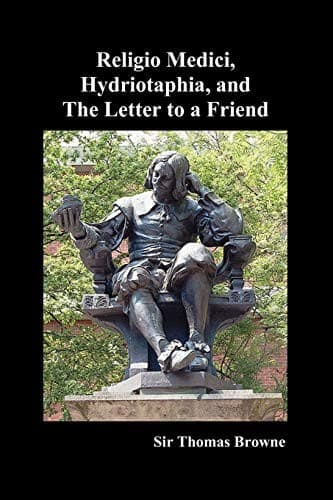
Religio Medici, Hydriotaphia, and the Letter to a FriendBrowne, Thomas, Sir
Religion
Religio Medici, Hydriotaphia, and the Letter to a Friend
Browne, Thomas, Sir
Christian ethics; Christian life; Essays; Funeral rites and ceremonies; Medical ethics; Medicine -- History; Religion and medicine
but the liberty of reason; and our waking conceptions do not match the
fancies of our sleeps. At my nativity, my ascendant was the watery sign
of _Scorpio_. I was born in the planetary hour of _Saturn_, and I think
I have a piece of that leaden planet in me. I am no way facetious,
nor disposed for the mirth and galliardise[99] of company; yet in one
dream I can compose a whole comedy, behold the action, apprehend the
jests, and laugh myself awake at the conceits thereof. Were my memory
as faithful as my reason is then fruitful, I would never study but
in my dreams, and this time also would I choose for my devotions:
but our grosser memories have then so little hold of our abstracted
understandings, that they forget the story, and can only relate to our
awaked souls a confused and broken tale of that which hath passed.
Aristotle, who hath written a singular tract of sleep, hath not,
methinks, thoroughly defined it; nor yet Galen, though he seem to have
corrected it; for those _noctambulos_ and night-walkers, though in
their sleep, do yet enjoy the action of their senses. We must therefore
say that there is something in us that is not in the jurisdiction
of Morpheus; and that those abstracted and ecstatick souls do walk
about in their own corpses, as spirits with the bodies they assume,
wherein they seem to hear, see, and feel, though indeed the organs are
destitute of sense, and their natures of those faculties that should
inform them. Thus it is observed, that men sometimes, upon the hour of
their departure, do speak and reason above themselves. For then the
soul beginning to be freed from the ligaments of the body, begins to
reason like herself, and to discourse in a strain above mortality.
_Sect._ 12.--We term sleep a death; and yet it is waking that kills
us, and destroys those spirits that are the house of life. ’Tis indeed
a part of life that best expresseth death; for every man truly lives,
so long as he acts his nature, or some way makes good the faculties of
himself. Themistocles therefore, that slew his soldier in his sleep,
was a merciful executioner: ’tis a kind of punishment the mildness of
no laws hath invented; I wonder the fancy of Lucan and Seneca did not
discover it. It is that death by which we may be literally said to die
daily; a death which Adam died before his mortality; a death whereby we
live a middle and moderating point between life and death. In fine, so
like death, I dare not trust it without my prayers, and an half adieu
unto the world, and take my farewell in a colloquy with God:--
Public-domain text, read in full here on John Shaqi.
Reviews
Reviews
No reviews yet
Be the first to share your thoughts on this work.
Elsewhere in the archive
Join the Discussion
Join the discussion
Sign in to leave a comment or review.
Sign InorCreate an account