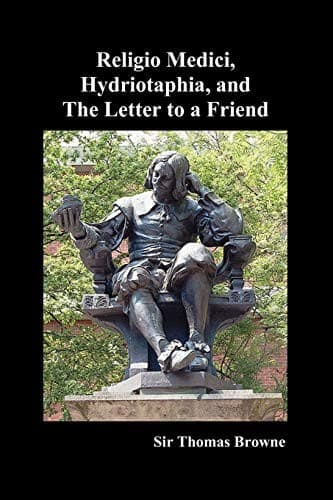
Religio Medici, Hydriotaphia, and the Letter to a FriendBrowne, Thomas, Sir
Religion
Religio Medici, Hydriotaphia, and the Letter to a Friend
Browne, Thomas, Sir
Christian ethics; Christian life; Essays; Funeral rites and ceremonies; Medical ethics; Medicine -- History; Religion and medicine
In brief, there can be nothing truly alone, and by its self, which is
not truly one, and such is only God: all others do transcend an unity,
and so by consequence are many.
[R] “Cic. de Off.,” 1. iii.
_Sect._ 11.--Now for my life, it is a miracle of thirty years, which
to relate, were not a history, but a piece of poetry, and would sound
to common ears like a fable. For the world, I count it not an inn, but
an hospital; and a place not to live, but to die in. The world that I
regard is myself; it is the microcosm of my own frame that I cast mine
eye on: for the other, I use it but like my globe, and turn it round
sometimes for my recreation. Men that look upon my outside, perusing
only my condition and fortunes, do err in my altitude; for I am above
Atlas’s shoulders.[98] The earth is a point not only in respect of
the heavens above us, but of the heavenly and celestial part within
us. That mass of flesh that circumscribes me limits not my mind. That
surface that tells the heavens it hath an end cannot persuade me I
have any. I take my circle to be above three hundred and sixty. Though
the number of the ark do measure my body, it comprehendeth not my
mind. Whilst I study to find how I am a microcosm, or little world, I
find myself something more than the great. There is surely a piece of
divinity in us; something that was before the elements, and owes no
homage unto the sun. Nature tells me, I am the image of God, as well as
Scripture. He that understands not thus much hath not his introduction
or first lesson, and is yet to begin the alphabet of man. Let me not
injure the felicity of others, if I say I am as happy as any. “_Ruat
cœlum, fiat voluntas tua,_” salveth all; so that, whatsoever happens,
it is but what our daily prayers desire. In brief, I am content; and
what should providence add more? Surely this is it we call happiness,
and this do I enjoy; with this I am happy in a dream, and as content
to enjoy a happiness in a fancy, as others in a more apparent truth
and reality. There is surely a nearer apprehension of anything that
delights us, in our dreams, than in our waked senses. Without this I
were unhappy; for my awaked judgment discontents me, ever whispering
unto me that I am from my friend, but my friendly dreams in the night
requite me, and make me think I am within his arms. I thank God for my
happy dreams, as I do for my good rest; for there is a satisfaction in
them unto reasonable desires, and such as can be content with a fit
of happiness. And surely it is not a melancholy conceit to think we
are all asleep in this world, and that the conceits of this life are
as mere dreams, to those of the next, as the phantasms of the night,
to the conceits of the day. There is an equal delusion in both; and
the one doth but seem to be the emblem or picture of the other. We are
somewhat more than ourselves in our sleeps; and the slumber of the body
seems to be but the waking of the soul. It is the ligation of sense,
Public-domain text, read in full here on John Shaqi.
Reviews
Reviews
No reviews yet
Be the first to share your thoughts on this work.
Elsewhere in the archive
Join the Discussion
Join the discussion
Sign in to leave a comment or review.
Sign InorCreate an account