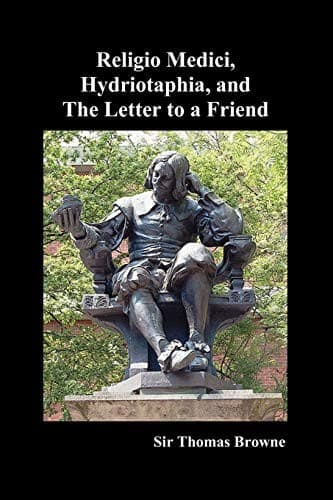
Religio Medici, Hydriotaphia, and the Letter to a FriendBrowne, Thomas, Sir
Religion
Religio Medici, Hydriotaphia, and the Letter to a Friend
Browne, Thomas, Sir
Christian ethics; Christian life; Essays; Funeral rites and ceremonies; Medical ethics; Medicine -- History; Religion and medicine
However, certain it is, that urns conceived of no Roman original, are
often digged up both in Norway and Denmark, handsomely described, and
graphically represented by the learned physician Wormius. And in some
parts of Denmark in no ordinary number, as stands delivered by authors
exactly describing those countries. And they contained not only bones,
but many other substances in them, as knives, pieces of iron, brass,
and wood, and one of Norway a brass gilded jew’s-harp.
Nor were they confused or careless in disposing the noblest sort,
while they placed large stones in circle about the urns or bodies
which they interred: somewhat answerable unto the monument of Rollrich
stones in England, or sepulchral monument probably erected by Rollo,
who after conquered Normandy; where ’tis not improbable somewhat might
be discovered. Meanwhile to what nation or person belonged that large
urn found at Ashbury,[AO] containing mighty bones, and a buckler; what
those large urns found at Little Massingham;[AP] or why the Anglesea
urns are placed with their mouths downward, remains yet undiscovered.
[AO] In Cheshire.
[AP] In Norfolk.
CHAPTER III.
PLAISTERED and whited sepulchres were anciently affected in cadaverous
and corrupted burials; and the rigid Jews were wont to garnish the
sepulchres of the righteous.[AQ] Ulysses, in Hecuba, cared not how
meanly he lived, so he might find a noble tomb after death.[AR]
Great princes affected great monuments; and the fair and larger urns
contained no vulgar ashes, which makes that disparity in those which
time discovereth among us. The present urns were not of one capacity,
the largest containing above a gallon, some not much above half that
measure; nor all of one figure, wherein there is no strict conformity
in the same or different countries; observable from those represented
by Casalius, Bosio, and others, though all found in Italy; while many
have handles, ears, and long necks, but most imitate a circular figure,
in a spherical and round composure; whether from any mystery, best
duration or capacity, were but a conjecture. But the common form with
necks was a proper figure, making our last bed like our first; nor
much unlike the urns of our nativity while we lay in the nether part
of the earth,[AS] and inward vault of our microcosm. Many urns are
red, these but of a black colour somewhat smooth, and dully sounding,
which begat some doubt, whether they were burnt, or only baked in
oven or sun, according to the ancient way, in many bricks, tiles,
pots, and testaceous works; and, as the word _testa_ is properly to
be taken, when occurring without addition and chiefly intended by
Pliny, when he commendeth bricks and tiles of two years old, and to
make them in the spring. Nor only these concealed pieces, but the open
magnificence of antiquity, ran much in the artifice of clay. Hereof the
house of Mausolus was built, thus old Jupiter stood in the Capitol,
Public-domain text, read in full here on John Shaqi.
Reviews
Reviews
No reviews yet
Be the first to share your thoughts on this work.
Elsewhere in the archive
Join the Discussion
Join the discussion
Sign in to leave a comment or review.
Sign InorCreate an account