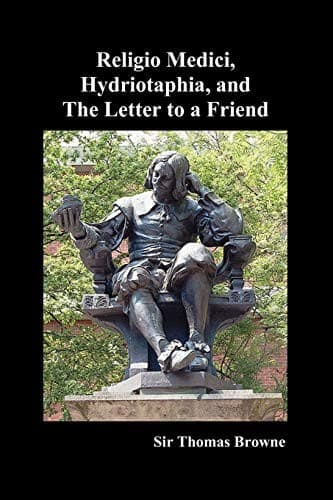
Religio Medici, Hydriotaphia, and the Letter to a FriendBrowne, Thomas, Sir
Religion
Religio Medici, Hydriotaphia, and the Letter to a Friend
Browne, Thomas, Sir
Christian ethics; Christian life; Essays; Funeral rites and ceremonies; Medical ethics; Medicine -- History; Religion and medicine
Christians dispute how their bodies should lie in the grave. In urnal
interment they clearly escaped this controversy. Though we decline the
religious consideration, yet in cemeterial and narrower burying-places,
to avoid confusion and cross-position, a certain posture were to be
admitted: which even Pagan civility observed. The Persians lay north
and south; the Megarians and Phœnicians placed their heads to the east;
the Athenians, some think, towards the west, which Christians still
retain. And Beda will have it to be the posture of our Saviour. That
he was crucified with his face toward the west, we will not contend
with tradition and probable account; but we applaud not the hand of
the painter, in exalting his cross so high above those on either side:
since hereof we find no authentic account in history, and even the
crosses found by Helena, pretend no such distinction from longitude or
dimension.
To be knav’d out of our graves, to have our skulls made drinking-bowls,
and our bones turned into pipes, to delight and sport our enemies, are
tragical abominations escaped in burning burials.
Urnal interments and burnt relicks lie not in fear of worms, or to
be an heritage for serpents. In carnal sepulture, corruptions seem
peculiar unto parts; and some speak of snakes out of the spinal marrow.
But while we suppose common worms in graves, ’tis not easy to find
any there; few in churchyards above a foot deep, fewer or none in
churches though in fresh-decayed bodies. Teeth, bones, and hair, give
the most lasting defiance to corruption. In an hydropical body, ten
years buried in the churchyard, we met with a fat concretion, where
the nitre of the earth, and the salt and lixivious liquor of the body,
had coagulated large lumps of fat into the consistence of the hardest
Castile soap, whereof part remaineth with us.[106] After a battle
with the Persians, the Roman corpses decayed in few days, while the
Persian bodies remained dry and uncorrupted. Bodies in the same ground
do not uniformly dissolve, nor bones equally moulder; whereof in the
opprobrious disease, we expect no long duration. The body of the
Marquis of Dorset[BG] seemed sound and handsomely cereclothed, that
after seventy-eight years was found uncorrupted. Common tombs preserve
not beyond powder: a firmer consistence and compage of parts might
be expected from arefaction, deep burial, or charcoal. The greatest
antiquities of mortal bodies may remain in putrefied bones, whereof,
though we take not in the pillar of Lot’s wife, or metamorphosis of
Ortelius, some may be older than pyramids, in the putrefied relicks
of the general inundation. When Alexander opened the tomb of Cyrus,
the remaining bones discovered his proportion, whereof urnal fragments
afford but a bad conjecture, and have this disadvantage of grave
interments, that they leave us ignorant of most personal discoveries.
For since bones afford not only rectitude and stability but figure
Public-domain text, read in full here on John Shaqi.
Reviews
Reviews
No reviews yet
Be the first to share your thoughts on this work.
Elsewhere in the archive
Join the Discussion
Join the discussion
Sign in to leave a comment or review.
Sign InorCreate an account