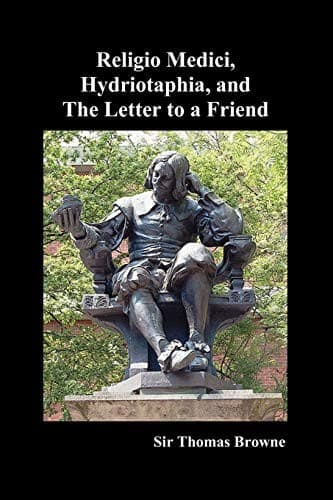
Religio Medici, Hydriotaphia, and the Letter to a FriendBrowne, Thomas, Sir
Religion
Religio Medici, Hydriotaphia, and the Letter to a Friend
Browne, Thomas, Sir
Christian ethics; Christian life; Essays; Funeral rites and ceremonies; Medical ethics; Medicine -- History; Religion and medicine
From animals are drawn good burning lights, and good medicines against
burning. Though the seminal humour seems of a contrary nature to fire,
yet the body completed proves a combustible lump, wherein fire finds
flame even from bones, and some fuel almost from all parts; though the
metropolis of humidity[BC] seems least disposed unto it, which might
render the skulls of these urns less burned than other bones. But
all flies or sinks before fire almost in all bodies: when the common
ligament is dissolved, the attenuable parts ascend, the rest subside in
coal, calx, or ashes.
[BC] The Brain. _Hippocrates_.
To burn the bones of the king of Edom for lime,[BD] seems no irrational
ferity; but to drink of the ashes of dead relations,[BE] a passionate
prodigality. He that hath the ashes of his friend, hath an everlasting
treasure; where fire taketh leave, corruption slowly enters. In
bones well burnt, fire makes a wall against itself; experimented in
Copels,[105] and tests of metals, which consist of such ingredients.
What the sun compoundeth, fire analyzeth, not transmuteth. That
devouring agent leaves almost always a morsel for the earth, whereof
all things are but a colony; and which, if time permits, the mother
element will have in their primitive mass again.
[BD] Amos ii. 1.
[BE] As Artemisia of her husband Mausolus.
He that looks for urns and old sepulchral relicks, must not seek them
in the ruins of temples, where no religion anciently placed them. These
were found in a field, according to ancient custom, in noble or private
burial; the old practice of the Canaanites, the family of Abraham, and
the burying-place of Joshua, in the borders of his possessions; and
also agreeable unto Roman practice to bury by highways, whereby their
monuments were under eye:--memorials of themselves, and mementoes of
mortality unto living passengers; whom the epitaphs of great ones were
fain to beg to stay and look upon them,--a language though sometimes
used, not so proper in church inscriptions.[BF] The sensible rhetorick
of the dead, to exemplarity of good life, first admitted to the bones
of pious men and martyrs within church walls, which in succeeding ages
crept into promiscuous practice: while Constantine was peculiarly
favoured to be admitted into the church porch, and the first thus
buried in England, was in the days of Cuthred.
[BF] Siste, viator.
Public-domain text, read in full here on John Shaqi.
Reviews
Reviews
No reviews yet
Be the first to share your thoughts on this work.
Elsewhere in the archive
Join the Discussion
Join the discussion
Sign in to leave a comment or review.
Sign InorCreate an account