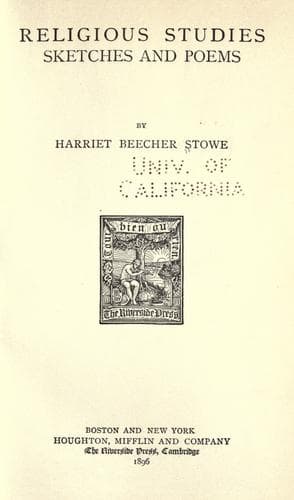
Religious Studies, Sketches and PoemsStowe, Harriet Beecher
Religion
Religious Studies, Sketches and Poems
Stowe, Harriet Beecher
Religion
It would appear that Judas had at first a sort of worldly enthusiasm
for Christ and his kingdom; that he received the divine gift of
miracle-working; that he went forth preaching and healing, and felt
all the exultation and joy which the sense of spiritual power and
influence gives. Judas was among those who returned from the first
missionary tour in triumph, saying, "Lord, even the devils were
subject unto us!" The grave answer of Jesus reminded them that it
was of far more importance to be really accepted of God as true
Christians than to have the most brilliant gifts and powers.
In our Lord's first Sermon on the Mount, which may be considered as
an ordaining charge to his Apostles, he had said to them that in
the great final day of Judgment there would be many who would say
unto him, "Lord, have we not prophesied in thy name, and in thy name
cast out devils, and in thy name done many wonderful works? and then
will I say to them, I never knew you; depart from me, ye that work
iniquity." Everywhere in the New Testament these miraculous powers
are spoken of as something of far less value than the true Christian
spirit, and, if we may trust the word of our Master, many had them
whom he will never acknowledge for his own.
But the warning fell on the ear of Judas unheeded. Perhaps he did
not himself know how selfish and self-seeking was his zeal for
the coming kingdom. Generally speaking, the first person deceived
by a man who plays a false part is himself. Judas appears not to
have excited the suspicions of the little company of brethren.
His shrewdness and tact in managing financial matters led them to
appoint him the treasurer of the common family purse. Without doubt,
what he saw of the enthusiastic love which Jesus excited, the ease
with which he could make people willing to lay their fortunes at his
feet, opened to his view dazzling golden visions. He saw himself
treasurer of a kingdom unequaled in splendor and riches, when all
the kingdoms of the world should be subject to his master. It was
more than the reign of Solomon, when gold was to be as the stones of
the street.
If we notice our Lord's teachings delivered in the hearing of Judas,
we must be struck with the explicit and forcible manner in which he
constantly pointed out the danger of the worldly spirit which was
growing upon that disciple. How solemn the picture of the rich man,
absorbed in plans and calculations how to bestow his great wealth
until God says to him, "Thou fool! this night shall thy soul be
required of thee--then whose shall those things be that thou hast
provided?" "So," he adds, "is every one that layeth up riches, and
is not rich towards God." Again, he tells them that it is easier for
a camel to go through a needle's eye than for a rich man to enter
into the kingdom of God. He asks them, What shall it profit a man if
he gain the whole world and lose his own soul?
Public-domain text, read in full here on John Shaqi.
Reviews
Reviews
No reviews yet
Be the first to share your thoughts on this work.
Elsewhere in the archive
Join the Discussion
Join the discussion
Sign in to leave a comment or review.
Sign InorCreate an account