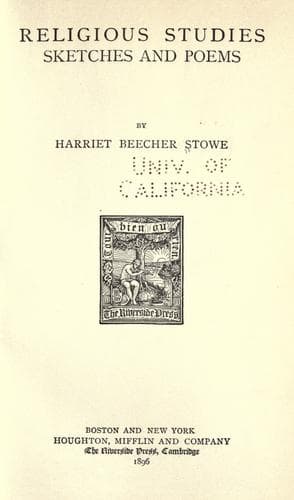
Religious Studies, Sketches and PoemsStowe, Harriet Beecher
Religion
Religious Studies, Sketches and Poems
Stowe, Harriet Beecher
Religion
"And the people that stood beholding, and the rulers also
with them, derided him, saying, He saved others; let him save
himself, if he be Christ, the chosen of God. And the soldiers
also mocked him, coming to him and offering him vinegar; and one
of the malefactors railed on him, saying, If thou be the Son of
God, save thyself and us. But the other answering, rebuked him,
saying, Dost thou not fear God, seeing that thou art in the same
condemnation?--and we, indeed, justly, for we receive the reward
of our deeds; but this man hath done nothing amiss. And he said
to Jesus, Lord, remember me when thou comest into thy kingdom.
And Jesus said unto him, _Verily, I say unto thee, to-day thou
shalt be with me in Paradise_."
Still unvanquished by pain, he is even with his last breath
pronouncing words of grace and consolation for the guilty and
repentant! He is mighty to save even in his humiliation!
The third utterance is recorded by St. John as follows:--
"Now there stood by the cross of Jesus his mother, and his
mother's sister, Mary the wife of Cleophas, and Mary Magdalene.
When Jesus, therefore, saw his mother standing, and the
disciple whom he loved, he said to his mother, _Woman, behold
thy son_, and to the disciple, _Son, behold thy mother_."
Thus far, every utterance of Jesus has been one of thoughtful
consideration for others, of prayer for his enemies, of grace and
pardon to the poor wretch by his side, and of tenderness to his
mother and disciple. But in tasting death for every man our Lord was
to pass through a deeper experience; he was to know the sufferings
of the darkened brain, which, clogged and impeded by the obstructed
circulation, no longer afforded a clear medium for divine communion.
He was to suffer the eclipse which the animal nature in its dying
state can interpose between the soul and God. Three hours we are
told had passed, when there was darkness over all the land, like
that that was slowly gathering over the head of the suffering Lord.
"And at the ninth hour Jesus cried with a loud voice, saying, _Eloi,
Eloi, lama sabacthani_, which is, being interpreted, My God, my
God, why hast thou forsaken me?" Those words, from the Psalm of
David, come now as the familiar language expressive of that dreadful
experience to which the whole world looks as its ransom:--
"After that, Jesus said, _I thirst_. And one ran and filled a
sponge full of vinegar and put it on a reed and gave him to
drink. And when he had received the vinegar, he said, _It is
finished_, and he bowed his head."
What we read of his last utterance is that "he cried with a loud
voice, and gave up the ghost." This last loud utterance was in the
words, "Father, into thy hands I commend my spirit."
Public-domain text, read in full here on John Shaqi.
Reviews
Reviews
No reviews yet
Be the first to share your thoughts on this work.
Elsewhere in the archive
Join the Discussion
Join the discussion
Sign in to leave a comment or review.
Sign InorCreate an account