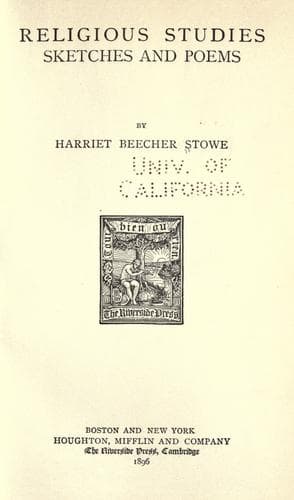
Religious Studies, Sketches and PoemsStowe, Harriet Beecher
Religion
Religious Studies, Sketches and Poems
Stowe, Harriet Beecher
Religion
It is the interpretation that the church has given to these last
words that they betokened a sudden flame of joyful perception,
such as sometimes lights up the brain at the dying moment, after
it has been darkened by the paralysis of death. As he said, "It is
finished," light, and joy, and hope, flushed his soul, and with
this loud cry of victory and joy, it departed like a ray of heavenly
light to the bosom of the Father.
Such were the seven "last utterances" of Jesus--and when can we
hope to attain to what they teach? When shall _we_ be so grounded
in Love that no tumult or jar of outward forces, no insults, no
physical weariness, exhaustion, or shock of physical pain, shall
have power to absorb us in selfishness, or make us forgetful of
others? When shall pity and prayer be the only spontaneous movement
of our hearts when most hurt and injured--pierced in the tenderest
nerve? When shall thoughtfulness for others, and divine pity for
degraded natures, be the immovable habit of our souls? How little of
_self_ and its sufferings in these last words; how much of pity and
love--the pity and love of a God!
Could we but learn life's lessons by them, then will come at last to
us the final hour, when, _our_ trial being completed, we shall say
"It is finished," and pass like him to the bosom of the Father.
XXVIII
THE DARKEST HOUR
_Good Friday Evening_
What is the darkest hour to us when our friends die? Not the dying
hour; for then love has some last act, some last word to receive,
some comfort to give, some service to render, that diverts from the
bitterness of pain. Not even when the eyes are closed forever, and
the face is fixed in marble stillness; for still we gather at the
side of the cold clay and feel as if there were something left us of
our love. But when we have carried our dear ones to the grave, and
seen the doors of the sepulchre shut between them and us, and come
back to the house where they are no more--where they never more may
be--_then_ is indeed the darkest hour.
There is a very touching picture by Delaroche entitled "The Return
from the Cross," in which the mother of Jesus, leaning on the arm
of the beloved John, is seen just entering a lowly dwelling. A few
faithful friends, men and women, are with them; they have seen him
die--seen him laid in the sepulchre and a great stone rolled against
the door; and now they are come to their desolate home to think it
all over, and to weep.
Do we ask, Why did they not remember the words of Jesus, that he
should rise again? Ah! because they had just such hearts as we have,
and their faith was overpowered by sight just as ours is.
Public-domain text, read in full here on John Shaqi.
Reviews
Reviews
No reviews yet
Be the first to share your thoughts on this work.
Elsewhere in the archive
Join the Discussion
Join the discussion
Sign in to leave a comment or review.
Sign InorCreate an account