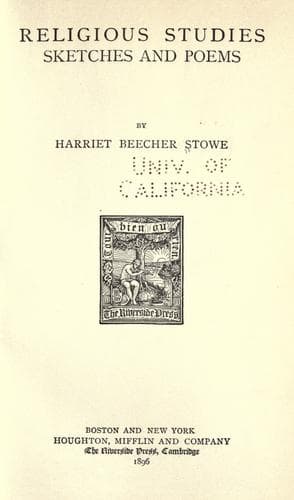
Religious Studies, Sketches and PoemsStowe, Harriet Beecher
Religion
Religious Studies, Sketches and Poems
Stowe, Harriet Beecher
Religion
Stanch men were they--these Puritan fathers of Andover. The old
oak must have felt them something akin to himself. Such strong,
wrestling limbs had they, so gnarled and knotted were they, yet so
outbursting with a green and vernal crown, yearly springing, of
noble and generous thoughts, rustling with leaves which shall be for
the healing of nations.
These men were content with the hard, dry crust for themselves,
that they might sow seeds of abundant food for us, their children;
men out of whose hardness in enduring we gain leisure to be soft
and graceful, through whose poverty we have become rich. Like
Moses, they had for their portion only the pain and weariness of
the wilderness, leaving to us the fruition of the promised land.
Let us cherish for their sake the old oak, beautiful in its age as
the broken statue of some antique wrestler, brown with time, yet
glorious in its suggestion of past achievement.
I think all this the more that I have recently come across the
following passage in one of our religious papers. The writer
expresses a kind of sentiment which one meets very often upon this
subject, and leads one to wonder what glamour could have fallen
on the minds of any of the descendants of the Puritans, that they
should cast nettles on those honored graves where they should be
proud to cast their laurels.
"It is hard," he says, "for a lover of the beautiful--not a
mere lover, but a believer in its divinity also--to forgive the
Puritans, or to think charitably of them. It is hard for him to keep
Forefathers' Day, or to subscribe to the Plymouth Monument; hard to
look fairly at what they did, with the memory of what they destroyed
rising up to choke thankfulness; for they were as one-sided and
narrow-minded a set of men as ever lived, and saw one of Truth's
faces only--the hard, stern, practical face, without loveliness,
without beauty, and only half dear to God. The Puritan flew in
the face of facts, not because he saw them and disliked them, but
because he did not see them. He saw foolishness, lying, stealing,
worldliness,--the very mammon of unrighteousness rioting in the
world and bearing sway,--and he ran full tilt against the monster,
hating it with a very mortal and mundane hatred, and anxious to see
it bite the dust that his own horn might be exalted. It was in truth
only another horn of the old dilemma, tossing and goring grace and
beauty, and all the loveliness of life, as if they were the enemies
instead of the sure friends of God and man."
Now, to those who say this we must ask the question with which
Socrates of old pursued the sophist: What is beauty? If beauty be
only physical, if it appeal only to the senses, if it be only an
enchantment of graceful forms, sweet sounds, then indeed there might
be something of truth in this sweeping declaration that the Puritan
spirit is the enemy of beauty.
Public-domain text, read in full here on John Shaqi.
Reviews
Reviews
No reviews yet
Be the first to share your thoughts on this work.
Elsewhere in the archive
Join the Discussion
Join the discussion
Sign in to leave a comment or review.
Sign InorCreate an account