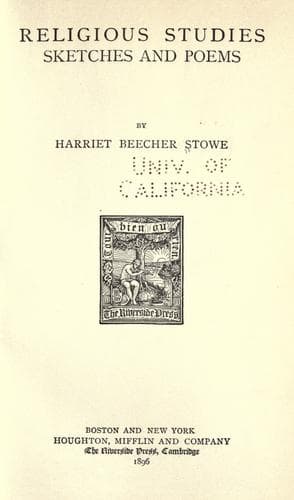
Religious Studies, Sketches and PoemsStowe, Harriet Beecher
Religion
Religious Studies, Sketches and Poems
Stowe, Harriet Beecher
Religion
The very root and foundation of all artistic inquiry lies here.
What is beauty? And to this question God forbid that we Christians
should give a narrower answer than Plato gave in the old times
before Christ arose, for he directs the aspirant who would discover
the beautiful to "consider of greater value the beauty existing
_in the soul_, than that existing in the body." More gracefully
he teaches the same doctrine when he tells us that "there are two
kinds of Venus (beauty); the one, the elder, who had no mother, and
was the daughter of Uranus (heaven), whom we name the celestial;
the other, younger, daughter of Jupiter and Dione, whom we call the
vulgar."
Now, if disinterestedness, faith, patience, piety, have a beauty
celestial and divine, then were our fathers worshipers of the
beautiful. If high-mindedness and spotless honor are beautiful
things, they had those. What work of art can compare with a lofty
and heroic life? Is it not better to be a Moses than to be a Michael
Angelo making statues of Moses? Is not the life of Paul a sublimer
work of art than Raphael's cartoons? Are not the patience, the
faith, the undying love of Mary by the cross, more beautiful than
all the Madonna paintings in the world. If, then, we would speak
truly of our fathers, we should say that, having their minds fixed
on that celestial beauty of which Plato speaks, they held in slight
esteem that more common and earthly.
Should we continue the parable in Plato's manner, we might say
that the earthly and visible Venus, the outward grace of art and
nature, was ordained of God as a priestess, through whom men were
to gain access to the divine, invisible One; but that men, in their
blindness, ever worship the priestess instead of the divinity.
Therefore it is that great reformers so often must break the shrines
and temples of the physical and earthly beauty, when they seek to
draw men upward to that which is high and divine.
Christ says of John the Baptist, "What went ye out for to see? A
man clothed in soft raiment? Behold they which are clothed in soft
raiment are in kings' palaces." So was it when our fathers came
here. There were enough wearing soft raiment and dwelling in kings'
palaces. Life in papal Rome and prelatic England was weighed down
with blossoming luxury. There were abundance of people to think of
pictures, and statues, and gems, and cameos, vases and marbles,
and all manner of deliciousness. The world was all drunk with the
enchantments of the lower Venus, and it was needful that these men
should come, Baptist-like in the wilderness, in raiment of camel's
hair. We need such men now. Art, they tell us, is waking in America;
a love of the beautiful is beginning to unfold its wings; but what
kind of art, and what kind of beauty? Are we to fill our houses
with pictures and gems, and to see that even our drinking cup and
vase are wrought in graceful pattern, and to lose our reverence for
self-denial, honor, and faith?
Public-domain text, read in full here on John Shaqi.
Reviews
Reviews
No reviews yet
Be the first to share your thoughts on this work.
Elsewhere in the archive
Join the Discussion
Join the discussion
Sign in to leave a comment or review.
Sign InorCreate an account