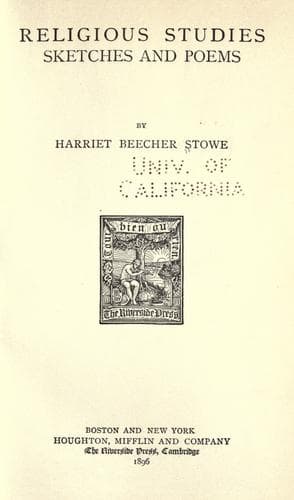
Religious Studies, Sketches and PoemsStowe, Harriet Beecher
Religion
Religious Studies, Sketches and Poems
Stowe, Harriet Beecher
Religion
"Why, no, not exactly," replied Miss B.; "in some cases it is
necessary to say something, so as not to appear rude."
"Very well," replied her uncle. "You admit, then, that some things,
which are not instructive in themselves considered, are to be said
to keep up the intercourse of society?"
"Certainly; some things," said Miss B.
"Well, now, in the case mentioned by Helen, when two or three people
with whom you are in different degrees of intimacy call upon you, I
think she is perfectly right, as she said, in talking of roses, and
canary-birds, and even of bonnet patterns, and lace, or anything
of the kind, for the sake of making conversation. It amounts to
the same thing as 'good-morning,' and 'good-evening,' and the
other courtesies of society. This sort of small talk has nothing
instructive in it, and yet it may be useful in its place. It makes
people comfortable and easy, promotes kind and social feelings; and
making people comfortable by any innocent means is certainly not a
thing to be despised."
"But is there not great danger of becoming light and trifling if one
allows this?" said Miss B. doubtfully.
"To be sure; there is always danger of running every innocent thing
to excess. One might eat to excess, or drink to excess; yet eating
and drinking are both useful in their way. Now, our lively young
friend Helen, here, might perhaps be in some temptation of this
sort; but as for you, Anna, I think you in more danger of another
extreme."
"And what is that?"
"Of overstraining your mind by endeavoring to keep up a constant,
fixed state of seriousness and solemnity, and not allowing yourself
the relaxation necessary to preserve its healthy tone. In order to
be healthy, every mind must have variety and amusement; and if you
would sit down at least one hour a day, and join your friends in
some amusing conversation, and indulge in a good laugh, I think,
my dear, that you would not only be a happier person, but a better
Christian."
"My dear uncle," said Miss B., "this is the very thing that I have
been most on my guard against; I can never tell stories, or laugh
and joke, without feeling condemned for it afterwards."
"But, my dear, you must do the thing in the testimony of a good
conscience before you can do it to any purpose. You must make up
your mind that cheerful and entertaining conversation--conversation
whose first object is to amuse--is useful conversation in its place,
and then your conscience will not be injured by joining in it."
"But what good does it do, uncle?"
"Do you not often complain of coldness and deadness in your
religious feelings? of lifelessness and want of interest?"
"Yes, uncle."
Public-domain text, read in full here on John Shaqi.
Reviews
Reviews
No reviews yet
Be the first to share your thoughts on this work.
Elsewhere in the archive
Join the Discussion
Join the discussion
Sign in to leave a comment or review.
Sign InorCreate an account