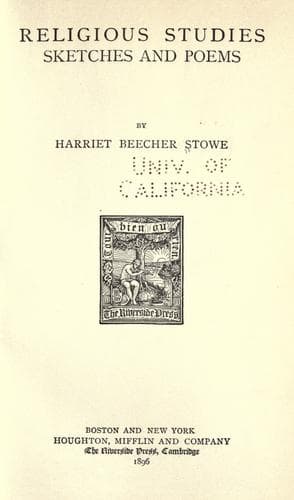
Religious Studies, Sketches and PoemsStowe, Harriet Beecher
Religion
Religious Studies, Sketches and Poems
Stowe, Harriet Beecher
Religion
"Well, this coldness and lifelessness is the result of forcing your
mind to one set of thoughts and feelings. You become worn out--your
feelings exhausted--deadness and depression ensue. Now, turn your
mind off from these subjects--divert it by a cheerful and animated
conversation, and you will find, after a while, that it will return
to them with new life and energy."
"But are not foolish talking and jesting expressly forbidden?"
"That text, if you will look at the connections, does not forbid
jesting in the abstract; but jesting on immodest subjects--which
are often designated in the New Testament by the phraseology there
employed. I should give the sense of it--neither filthiness, nor
foolish talking, nor indelicate jests. The kind of sprightly and
amusing conversation to which I referred, I should not denominate
foolish, by any means, at proper times and places."
"Yet people often speak of gayety as inconsistent in
Christians--even worldly people," said Miss B.
"Yes, because, in the first place, they often have wrong ideas as to
what Christianity requires in this respect, and suppose Christians
to be violating their own principles in indulging in it. In the
second place, there are some, especially among young people, who
never talk in any other way--with whom this kind of conversation
is not an amusement, but a habit--giving the impression that they
never think seriously at all. But I think, that if persons are
really possessed by the tender, affectionate, benevolent spirit
of Christianity--if they regulate their temper and their tongue
by it, and in all their actions show an evident effort to conform
to its precepts; they will not do harm by occasionally indulging
in sprightly and amusing conversation--they will not make the
impression that they are not sincerely Christians."
"Besides," said Helen, "are not people sometimes repelled from
religion by a want of cheerfulness in its professors?"
"Certainly," replied her uncle, "and the difference is just this:
if persons are habitually trifling and thoughtless, it is thought
that they have _no_ religion; if they are ascetic and gloomy it
is attributed to their religion; and you know what Miss E. Smith
says--that 'to be good and disagreeable is high treason against
virtue.' The more sincerely and earnestly religious a person is, the
more important it is that he should be agreeable."
"But, uncle," said Helen, "what does that text mean that we began
with? What are idle words?"
Public-domain text, read in full here on John Shaqi.
Reviews
Reviews
No reviews yet
Be the first to share your thoughts on this work.
Elsewhere in the archive
Join the Discussion
Join the discussion
Sign in to leave a comment or review.
Sign InorCreate an account