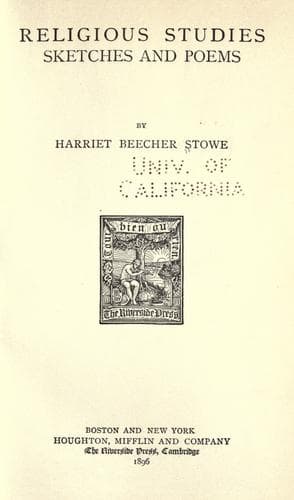
Religious Studies, Sketches and PoemsStowe, Harriet Beecher
Religion
Religious Studies, Sketches and Poems
Stowe, Harriet Beecher
Religion
"The last age of the Cumæan song is come.
The great cycle of ages hastens to a new beginning.
Now, too, returns the reign of Justice.
The golden age of Saturn now returns.
While thou, Pollio, art consul,
This glory of our age shall make his appearance.
The great months begin to roll.
He shall partake of the life of the gods,
And rule the peaceful world with his father's virtues."
Then follow a profusion of images of peace and plenty that should
come to the world in the reign of this hero. All poisonous and
hurtful things shall die; all rare and beautiful ones shall grow and
abound; there shall be no more toil, no more trouble. Then, with
a fine burst of imagery, the poet represents the Fates themselves
as singing, to the whirring music of their spindles, a song of
welcome:--
"Ye ages, hasten!
Dear offspring of the gods, set forward on thy way to highest honors;
The time is at hand.
See, the world with its round weight bows to thee.
To thee bow the earth, the regions of the sea and heaven sublime.
See how all things rejoice at the approach of this age!
O that my life might last to see and sing thy deeds!"
The close of this eclogue has a mysterious tenderness. The poet
predicts that this sublime personage, for whom the world is waiting,
should be born amidst the afflictions of his parents and under a
cloud of poverty and neglect:--
"Come, little boy, and know thy mother with a smile.
Come, little boy, on whom thy parents smile not,
Whom no god honors with a table,
No goddess with a cradle."
It would seem as if the sensitive soul of Virgil, in the ecstasy of
poetic inspiration, acquired a vague clairvoyance of that scene at
Bethlehem when there was no room for Joseph and Mary at the inn, and
the Heir of all things lay in a manger, outcast and neglected.
Not in Virgil alone, but scattered also here and there through all
antiquity, do we find vague, half-prophetic aspirations after the
divine Teacher who should interpret God to man, console under the
sorrows of life, and charm away the fears of death. In the Phædo,
when Socrates is comforting his sorrowful disciples in view of
his approaching death, and setting before them the probabilities
of a continued life beyond the grave, one of them tells him that
they believe while they hear him, but when he is gone their doubts
will all return, and says, "Where shall we find a charmer then to
disperse our fears?" Socrates answers that such a Charmer will yet
arise, and bids his disciples seek him in all lands of the earth.
Greece, he says, is wide, and there are many foreign lands and even
barbarous countries in which they should travel searching for Him,
for there is nothing for which they could more reasonably spend time
and money.
And in the discourse of Socrates with Alcibiades, as given by Plato,
the great philosopher is represented as saying, "We must wait till
One shall teach us our duty towards gods and men."
Public-domain text, read in full here on John Shaqi.
Reviews
Reviews
No reviews yet
Be the first to share your thoughts on this work.
Join the Discussion
Join the discussion
Sign in to leave a comment or review.
Sign InorCreate an account