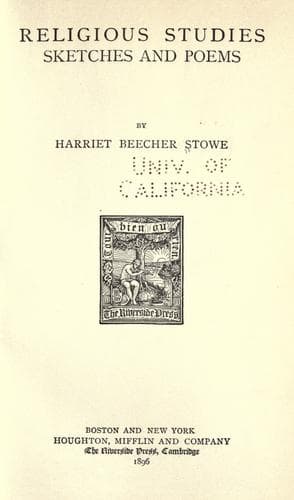
Religious Studies, Sketches and PoemsStowe, Harriet Beecher
Religion
Religious Studies, Sketches and Poems
Stowe, Harriet Beecher
Religion
The indignant answer of Jesus shows with what living energy he
repelled every thought of the least concession to evil, the least
advantage to be gained by following or allowing the corrupt courses
of this world. He would not flatter the rich and influential. He
would not conceal offensive truth. He would seek the society of the
poor and despised. He taught love of enemies in the face of a nation
hating their enemies and longing for revenge. He taught forgiveness
and prayer, while they were longing for battle and conquest. He
blessed the meek, the sorrowful, the merciful, the persecuted for
righteousness, instead of the powerful and successful. If he had
been willing to have been such a king as the Scribes and Pharisees
wanted they would have adored him and fought for him. But because
his kingdom was not of this world they cried: "Not this man, but
Barabbas!" It is said that after this temptation the Devil departed
from him "for a season." But all through his life, in one form or
another, that temptation must have been suggested to him.
When he told his Apostles that he was going up to Jerusalem to
suffer and to die, Peter, it is said, rebuked him with earnestness:
"That be far from thee, Lord; such things shall not happen to thee."
Jesus instantly replies, not to Peter, but to the Invisible Enemy
who through Peter's affection and ambition is urging the worldly and
self-seeking course upon him: "Get thee behind me, Satan, thou art
an offence unto me. Thou savorest not the things that be of God but
of man."
We are told that the temptation of Christ was so real that he
suffered, being tempted. He knew that he must disappoint the
expectations of all his friends who had set their hearts on the
temporal kingdom, that he was leading them on step by step to a
season of unutterable darkness and sorrow. The cross was bitter to
him, in prospect as in reality, but never for a moment did he allow
himself to swerve from it. As the time drew near, he said, "Now is
my soul troubled, and what shall I say? Father, save me from this
hour? But, for this cause came I unto this hour;--Father, glorify
thy name!"
Is not this lifelong temptation which Christ overcame one that meets
us all every day and hour? To live an unworldly life; never to seek
place or power or wealth by making the least sacrifice of conscience
or principle; is it easy? is it common? Yet he who chose rather to
die on the cross than to yield in the slightest degree his high
spiritual mission can feel for our temptations and succor us even
here.
Public-domain text, read in full here on John Shaqi.
Reviews
Reviews
No reviews yet
Be the first to share your thoughts on this work.
Join the Discussion
Join the discussion
Sign in to leave a comment or review.
Sign InorCreate an account