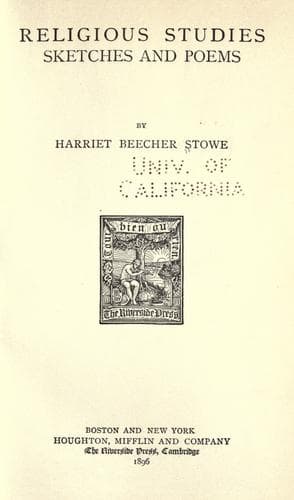
Religious Studies, Sketches and PoemsStowe, Harriet Beecher
Religion
Religious Studies, Sketches and Poems
Stowe, Harriet Beecher
Religion
The new dispensation that Jesus came to introduce was something as
yet uncomprehended on earth. It was a heavenly ideal, and these
men--simple, pure-hearted, and devout as they were--had no more
conception of it than a deaf person has of music. It was a new
manner of life, a new style of manhood, that was to constitute
this kingdom of Heaven. It was no outward organization--no earthly
glory. Man was to learn to live, not by force, not by ambition,
not by pleasure, but by LOVE. Man was to become perfect in love
as God is, so that loving and serving and suffering for others
should become a fashion and habit in this world, where ruling and
domineering and making others suffer had been the law. And Jesus
took into his family twelve men to prepare them to be the Apostles
of this idea. His mode was more that of a mother than a father.
He strove to infuse Himself into them by an embracing, tender,
brooding love; ardent, self-forgetful, delicate, refined. As we
read the New Testament narrative of the walks and talks of Jesus
with these chosen ones, their restings by the wayside, their family
conversations at evening, when he sat with some little child on his
knee, when he listened to their sayings, reproved their failings,
settled their difficulties with one another, we can see no image
by which to represent the Master but one of those loving, saintly
mothers, who, in leading along their little flock, follow nearest in
the footsteps of Jesus.
Jesus trusted more to personal love, in forming his church, than to
any other force. The power of love in developing the intellect and
exciting the faculties is marked, even on the inferior animals. The
dog is changed by tender treatment and affectionate care; he becomes
half human, and seems to struggle to rise out of the brute nature
toward a beloved master. Rude human natures are correspondingly
changed, and he who has great power of loving and exciting love may
almost create anew whom he will.
Jesus, that guest from brighter worlds, brought to this earth the
nobler ideas of love, the tenderness, the truth, the magnanimity,
that are infinite in the All-Loving. What of God could be expressed
and understood by man He was, and St. John says of his ethereal
gentleness and sweetness of nature: "The light shined in the
darkness and the darkness comprehended it not."
The varieties of natural character in this family of Jesus were
such as to give most of the usual differences of human beings. The
Master's object was to unite them to each other by such a love that
they should move by a single impulse, as one human being, and that
what was lacking in one might be made up by what was abundant in
another. As He expressed it in his last prayer: "That they all may
be one, as Thou, Father, art in me and I in Thee, that they also may
be one in us: that the world may believe that Thou hast sent me."
Public-domain text, read in full here on John Shaqi.
Reviews
Reviews
No reviews yet
Be the first to share your thoughts on this work.
Join the Discussion
Join the discussion
Sign in to leave a comment or review.
Sign InorCreate an account