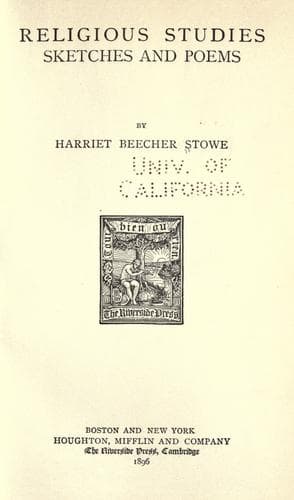
Religious Studies, Sketches and PoemsStowe, Harriet Beecher
Religion
Religious Studies, Sketches and Poems
Stowe, Harriet Beecher
Religion
The Protestant must not forbid the Romanist mission whose plain
object seems to be to call sinners to repentance, and to lead
professing Christians to a higher and holier life; nor must the
Romanist in the pride of ancient authority forbid the Protestant
evangelist that is seeking to make known the love of Jesus. And
there are men in our times, of pure natures and of real love for
mankind, whose faith in divine revelation is shaken, who no longer
dare to say they believe with the "orthodox," but who yet are
faithfully striving to do good to man, to heal the sick and cast out
the devils that afflict society. Sad-hearted men are they often,
working without the cheer that inspires the undoubting believer,
often under a sense of the ban of the professed followers of Christ;
yet the infinite tolerance of our Lord is leading them as well as
those who more formally bear his name.
It was Cyrus, the Persian king, who worshiped the Zoroastrian gods,
that is called in the prophecy "God's shepherd;" to whom God says,
"Cyrus, whose right hand I have holden, I girded thee, though thou
hast not known me."
Let us hope that there are many whose right hand Christ is holding,
though they as yet know him not; for He it is who says:--
"I will bring the blind by a way they know not. I will make
darkness light before them, and crooked things straight: these
things will I do unto them and not forsake them."
It pleased our Lord to number among the twelve Apostles one of
those natures which are constitutionally cautious and skeptical.
Thomas had a doubting head but a loving heart; he clung to Christ
by affinity of spirit and personal love, with a slow and doubting
intellect. Whether Jesus were the Messiah, the King of Israel,
destined to reign and conquer, Thomas, though sometimes hoping,
was somewhat prone to doubt. He was all the while foreboding that
Christ would be vanquished, while yet determined to stand by him to
the last. When Christ announced his purpose to go again into Judæa,
where his life had been threatened, Thomas says,--and there seems
to be a despairing sigh in the very words,--"Let us also go, that
we may die with him." The words seemed to say, "this man may be
mistaken, after all; but, living or dying, I must love him, and if
he dies, I die too."
Well, the true-hearted doubter lived to see his Lord die, and he it
was, of all the disciples, who refused to believe the glad news of
the resurrection. No messenger, no testimony, nothing that anybody
else had seen could convince him. He must put his own hand into the
print of the nails or he will not believe. The gracious Master did
not refuse the test. "Reach hither thy finger and behold my hand,
and reach hither thy hand and thrust it into my side, and be not
faithless but believing," he said, and the doubter fell at his feet
and cried, "My Lord and my God!"
Public-domain text, read in full here on John Shaqi.
Reviews
Reviews
No reviews yet
Be the first to share your thoughts on this work.
Elsewhere in the archive
Join the Discussion
Join the discussion
Sign in to leave a comment or review.
Sign InorCreate an account