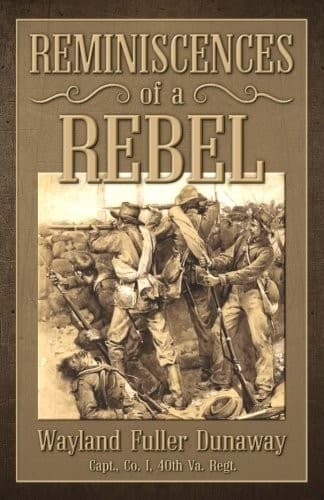
United States -- History -- Civil War, 1861-1865 -- Personal narratives, Confederate
The train that was to convey us southward was made up of box-cars, upon
the floors of which there was a thin covering of straw. We were so
crowded that we all could not lie down at the same time. The sleepers
lay with their heads at the sides of the cars, while their legs
interlaced in the middle. We took the situation in good humor, and slept
by turns, those who could not find room standing amidst entangled legs
and feet. Thus we traveled several days and nights, our train being
frequently switched for the passage of regular trains. Our route was by
Bellaire to Baltimore, or rather to Locust Point, where we took passage
on a steamboat for James river. Having landed the next day, we walked
across a neck of land formed by a bend of the river to the wharf where a
boat from Richmond was expected to meet us. A company of negroes made a
show of conducting us across the neck, though a company of children
armed with cornstalks would have been equally efficient.
We had not long to wait until the smokestack of the Confederate
steamboat could be seen winding along as she tracked the serpentine
course of the river. As she neared the wharf the band on board struck up
that sweetest of tunes,--"Home, Sweet Home." Some of my companions
laughed, some threw their caps into the air, others hurrahed, while my
own emotions were expressed only by tears of joy that coursed down my
cheeks. When, however, the music glided into the exhilarating notes of
"Dixie" I joined in the cheering that mingled with the strain.
We arrived in Richmond on the 22d of March, the eighth day after we had
started. I was pained to notice in the city so many signs of
delapidation and poverty, and to learn that Confederate money had
depreciated to the point of sixty for one. The captain's salary that the
government owed me for two years was worth only about fifty dollars in
specie, which a friend in the treasury department advised me to collect
at once, inasmuch as he thought that the capital would be soon
evacuated. I took him for a timorous prophet, and told him I would wait
until I rejoined the army, when I should need it. I did not know, as he
did, the impoverished and critical condition of the Confederacy.
Public-domain text, read in full here on John Shaqi.
Reviews
Reviews
No reviews yet
Be the first to share your thoughts on this work.
Join the Discussion
Join the discussion
Sign in to leave a comment or review.
Sign InorCreate an account