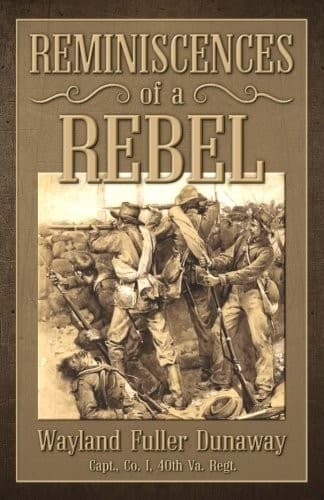
United States -- History -- Civil War, 1861-1865 -- Personal narratives, Confederate
From the summer of 1861 until the spring of 1862 we spent the time in
company and regimental drill, and in picketing the shore of the Potomac
river day and night, lest the enemy should effect a landing and take us
unaware. During that time no shots were exchanged with the enemy,
because no landing was attempted. The only fighting that we saw was at
Dumfries where there was a Confederate fort, to which we marched to act
as a support in case the Yankees came ashore. Three vessels of the
Federal navy passed slowly down the river, between which and the fort
there was a brief but lively cannonade; but so far as I know there was
no resulting damage to either side.
On Sunday, July 21, we heard the booming of the cannon at Bull Run,
lamenting that we had no part in the battle. When we afterward heard how
McDowell's army skedaddled back to Washington more rapidly than they
came, we thought that the war would end without our firing a gun. So
little did we understand the firmness of President Lincoln's mind and
the settled purpose of the North!
The winter was spent in comparative comfort, for we moved out of tents
into cabins built of pine logs, each one having a wide arch and a
chimney. At Christmas some good things were sent to me, among which was
a dressed turkey, which I did not know how to prepare for the table, for
even if I had possessed some knowledge of the culinary art there was no
suitable oven. Fortunately a comrade by the name of John Cook,--an
appropriate name for that occasion,--came to my relief and solved the
problem in a most satisfactory manner. The bird was suspended by a
string before the open fire, and being continually turned right and
left, and basted with grease from a plate beneath, it was beautifully
browned and cooked to a turn.
CHAPTER III
Drummer, strike up, and let us march away.
--SHAKESPEARE'S _Henry VI_.
In the spring of 1862 Gen. George B. McClellan with an army of 120,000
men, thoroughly drilled and lavishly equipped, set out from Washington
to capture Richmond from the north; but he had not proceeded far before
he changed his mind about the line of advance. His forces were
transported to Fortress Monroe with the design of approaching the city
by the way of the peninsula that lies between the York and the James
rivers. The correctness of his judgment was justified by subsequent
campaigns; for the successive attempts of Pope, Burnside, Hooker, and
Grant to take the Confederate capital from the north were all disastrous
failures.
Public-domain text, read in full here on John Shaqi.
Reviews
Reviews
No reviews yet
Be the first to share your thoughts on this work.
Join the Discussion
Join the discussion
Sign in to leave a comment or review.
Sign InorCreate an account