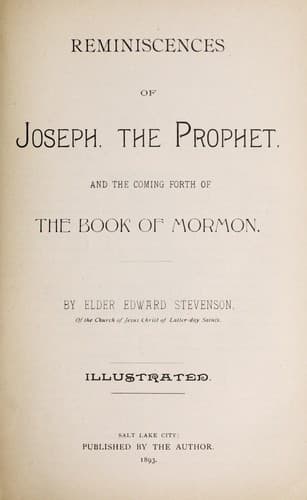
Reminiscences of Joseph, the Prophet, and the Coming Forth of the Book of MormonStevenson, Edward
Religion
Reminiscences of Joseph, the Prophet, and the Coming Forth of the Book of Mormon
Stevenson, Edward
Book of Mormon; Latter Day Saint churches; Smith, Joseph, Jr., 1805-1844
Notwithstanding every one of these three witnesses withdrew from the
Church in 1838, yet they remained firm in their declarations to the
truth of their testimony. Nine years afterwards Oliver Cowdery returned
to the church and was rebaptized. In 1871 Martin Harris came to Utah,
and he also was rebaptized. David Whitmer, who died at Richmond, Ray
Co., Mo., was the only one of the three who died without rebaptism. He
had resided in that place nearly fifty years, and many leading citizens
of Richmond signed their names, which were published, testifying that
David Whitmer was an honorable citizen whose veracity was unquestioned.
I can testify to the truth of these statements, for I visited him in
1870, also in 1879, and again in 1886. I was acquainted with him in
1833 and also in 1838 when he was disfellowshipped by the Church at
Far West, Mo. It was no secret among those who knew him at his home in
Richmond that he always stood firm to his testimony, as above stated.
The other two witnesses were equally valiant, both while in full
fellowship and after withdrawing from the Church, and I defy the world
to impeach either of those three witnesses.
Joseph Smith could not have accomplished the work entrusted to him
without the aid of the Urim and Thummim. It was therefore provided for
him. Anciently it was used by God's servants--His prophets, seers and
revelators. The language engraven upon the gold plates is Reformed
Egyptian and is spoken of in the Book of Mormon, which says:
"And now behold, we have written this according to our knowledge
in the characters which are called among us the Reformed Egyptian,
being handed down and altered by us, according to our manner of
speech."_--Book of Mormon, p.570, N. E._
And the thirty-fourth verse says:
"But the Lord knoweth the things which we have written, and that none
other people knoweth our language; therefore hath he prepared means
for the interpretation thereof."
There is still another instance worth mentioning. King Limhi was
in possession of twenty-four gold plates, and desired to have them
translated. Ammon told the king:
"I can assuredly tell thee, O king, of a man who can translate the
records; for he has wherewith that he can look and translate all
records that are of ancient date; and it is a gift from God, and the
things are called interpreters."_--Book of Mormon, p. 30, N. E._
"And now he translated them by the means of those two stones which
were fastened into the two rims of a bow. Now these things were
prepared from the beginning, and were handed down from generation
to generation, for the purpose of interpreting language."_--Book of
Mormon, p. 228, 13-14 v._
"And whosoever has these things is called Seer, after the manner of
old times."_--Book of Mormon, p. 228, 16 v._
By the above we learn that the Urim and Thummim or interpreters was
anciently used, and answered the description of those that Joseph is
represented as receiving.
Public-domain text, read in full here on John Shaqi.
Reviews
Reviews
No reviews yet
Be the first to share your thoughts on this work.
Join the Discussion
Join the discussion
Sign in to leave a comment or review.
Sign InorCreate an account