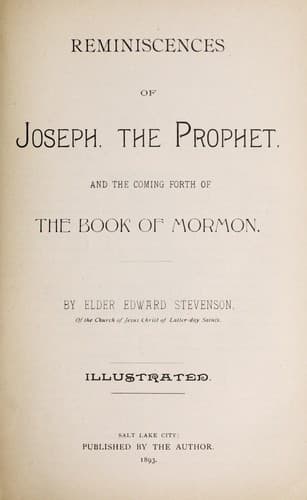
Reminiscences of Joseph, the Prophet, and the Coming Forth of the Book of MormonStevenson, Edward
Religion
Reminiscences of Joseph, the Prophet, and the Coming Forth of the Book of Mormon
Stevenson, Edward
Book of Mormon; Latter Day Saint churches; Smith, Joseph, Jr., 1805-1844
All these plates were fastened together with three great rings, so
that each plate could be turned over in the same manner as if hinged
together. So we are led to see that these people were very skilled,
and were also careful in preserving their history. That history brings
to light who the people were that left so many ruined cities, towers,
temples and other relics, many of which are found with hieroglyphics of
a similar character to the seven lines presented. The Book of Mormon,
translated from those plates, makes a book of 623 pages, and is at
the present time printed in about fifteen different languages. In the
box with the gold plates was a breast-plate made of gold and valued
at about five hundred dollars. Attached to this breast-plate was a
Urim and Thummim or interpreters. The latter was in form like unto
an old-fashioned pair of spectacles, two clear stones set in rims of
silver. I have conversed with Martin Harris, who handled them, and he
said he had placed them as he would a pair of spectacles, but they were
too large for him, as if they had been made for a larger race of people
than the present generation.
This Urim and Thummim was similar to what we read of in the Bible of
olden times and which only belonged to seers, revelators and prophets.
These were hidden with the book, to help the one to whom they should be
entrusted to translate them correctly.
The hill from whence those plates were taken is fully described in
another chapter.
I will vouch for the correctness of the characters, as I have compared
them with the original copy, which is still in existence, intact,
just as it was when Martin Harris, as a messenger, took it with the
translation Joseph Smith had made, to Professor Anthon of New York.
The copy here presented was traced from the original copy, and this
engraving, made by Mr. John Held, of Salt Lake City, is an exact
reproduction of it.
In the year 1871 I was favored with the privilege of bringing Martin
Harris from Kirtland, Ohio, to Utah. While on our journey, I had many
opportunities of conversing with him upon this subject, as well as
upon many other incidents which occurred at the early period of the
translation. Soon after presenting the seven lines of characters to
Professor Anthon, be (Martin Harris) aided the young Prophet by acting
as scribe during a portion of the translation. The learned Professor
Anthon, after having the lines of characters presented to him, examined
them carefully, and gave a certificate stating that they were Egyptian
characters and had been correctly translated. Mr. Harris, with the
certificate, started to leave, but when he had advanced as far as the
door, the Professor called to him, asking where he obtained those
plates. Harris replied:
"In a hill near Palmyra, New York."
"Then bring the book to me and I will translate the plates for you."
"I can not do so," said Martin, "for a part of them is sealed."
Public-domain text, read in full here on John Shaqi.
Reviews
Reviews
No reviews yet
Be the first to share your thoughts on this work.
Join the Discussion
Join the discussion
Sign in to leave a comment or review.
Sign InorCreate an account