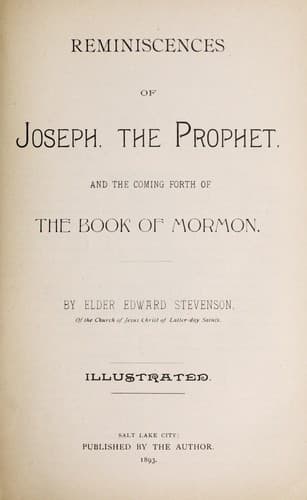
Reminiscences of Joseph, the Prophet, and the Coming Forth of the Book of Mormon — John Shaqi
Reminiscences of Joseph, the Prophet, and the Coming Forth of the Book of MormonStevenson, Edward
Religion
Reminiscences of Joseph, the Prophet, and the Coming Forth of the Book of Mormon
Stevenson, Edward
Book of Mormon; Latter Day Saint churches; Smith, Joseph, Jr., 1805-1844
Night was fast approaching, and flags of truce were passing between
the two lines, by which we learned that this formidable army was sent
out by Governor Boggs with orders to exterminate us. It was finally
concluded not to murder us that night, so the army withdrew until the
next morning, when they intended to make a final end of Mormonism.
They camped for the night on Goose Creek, one mile away from the city.
Thus ended one of the most eventful days of our lives. It fell to my
lot to stand guard that night, and the worst confusion and disorder
ever witnessed by human beings existed in the enemy's camp. This, with
unearthly yelling and howling, produced a real pandemonium very much
resembling my idea of hell. A sort of breast-work was constructed
during the night, made principally of wagons, house logs, etc. A dark
and dreary night was that. On the following day, October 31st, we
were preparing to meet death, if necessary, rather than surrender our
religion to a mob. We trusted in the Lord, however, and a better way
was prepared. Colonel Hinkle had been communicating with the enemy
during the day, and in the afternoon Joseph Smith and others passed
over the breast-works near where I and others were on duty. Colonel
Hinkle lead the party to meet the enemy, where he betrayed them into
their hands. This treachery on his part turned out for the best, for
God suffers offences to come, as in the case of Judas, "but woe to him
by whom they come."
On the following day, November 1st, 1838, we were marched into a hollow
square just outside of the city, where we delivered up about 630 guns,
grounded our arms, and advanced to the center of the square, where the
small arms and swords were left in a pile. The late Bishop McRae gave
six cuts with his sword and a pointer in the ground and left his sword
sticking there. We were left without the means of self-defense and at
the mercy of a conscienceless set of ignorant, prejudiced people, many
of whom, like St. Paul before his conversion, acted as if they were
doing God's service in destroying property and abusing the Mormons. My
widowed mother's house was plundered and my sister, now living here in
Utah, had her clothes taken from her in open day, leaving her destitute
of her necessary apparel.
General Wilson, who was one of the mobbers in Jackson County, was in
company with Joseph Smith soon after he was condemned to be shot.
Joseph asked General Wilson what he had done that he should be treated
with such indignity, stating that he had always been a supporter of the
Constitution and of good government. Wilson's reply was:
"I know it, and that is the reason I want to kill you, or have you
killed."
Subsequently this same Wilson said to P. P. Pratt and others:
Public-domain text, read in full here on John Shaqi.
Reviews
Reviews
No reviews yet
Be the first to share your thoughts on this work.
Join the Discussion
Join the discussion
Sign in to leave a comment or review.
Sign InorCreate an account