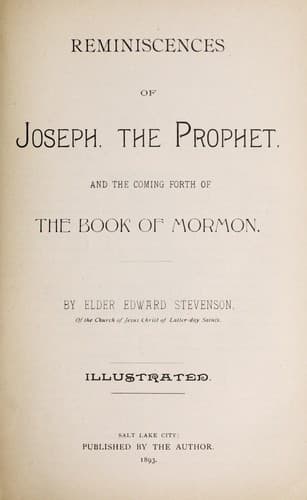
Reminiscences of Joseph, the Prophet, and the Coming Forth of the Book of Mormon — John Shaqi
Reminiscences of Joseph, the Prophet, and the Coming Forth of the Book of MormonStevenson, Edward
Religion
Reminiscences of Joseph, the Prophet, and the Coming Forth of the Book of Mormon
Stevenson, Edward
Book of Mormon; Latter Day Saint churches; Smith, Joseph, Jr., 1805-1844
"Our Patriarch and Prophet, too, Were massacred. They bled, To seal
their testimony, They were numbered with the dead."
CHAPTER II.
The Hill Cumorah, where the Plates of the Book of Mormon were Concealed
by Moroni and afterwards Delivered by him to Joseph Smith.--Some
Valuable History Pertaining to this Thrice-named Hill.
A beautiful picture of the Hill Cumorah is presented on the opposite
page. The hill is situated in the northwestern part of New York, about
thirty miles south of Rochester. It is also near the New York Central
Railroad, and only three and a half miles from Palmyra station to the
south, and on the Canandaigua turnpike.
This noted hill has been three times named and by three distinct and
great nations. For particulars concerning its historical importance
we begin our study in the year 1823. At that time there was found in
the side of this historic hill, by an obscure boy, a number of gold
plates. These plates were very ingeniously concealed in a stone box
and, bearing a record and being now translated, supply us with all the
earlier information contained on them.
There is a vast amount of valuable history pertaining to this hill,
which is far more picturesque than the hills which surround it. There
is an extensive valley on the east, as well as one on the west side
of the hill, where the turnpike runs south, passing through the town
of Manchester in the rear of the hill about two miles. Manchester, as
well as the Hill Cumorah, is situated in the township of Manchester.
The most prominent view of the hill is its north front. It extends
south nearly a mile, where it terminates into a more level plateau,
which is occupied as an agricultural district. From the highest point
of the hill, which is the northern end, where the writer has stood a
number of times, is one of the most lovely sights imaginable. To the
east is the New York Central Railroad, about four miles north is a most
lovely town named Palmyra, and two miles northwest is where the father
of Joseph Smith located a farm when the latter was only twelve years
of age. Finally, the whole country surrounding the hill from the most
elevated spot, as far as the natural vision can grasp, is indeed a most
charming scene of farms, orchards, houses, barns and rolling hills,
with occasional forests, and in the proper season, fields of golden
grain, barns well-filled, orchard trees laden with apples, peaches
and pears, with here and there patches of strawberries, raspberries,
blackberries, cherries, currants and garden vegetables in variety. All
of these beautiful scenes have engraven upon my mind a picture which
defies the artist's brush to place on canvas.
[Image: The Hill Cumorah.]
The first name given to this hill (and by a lost nation who left the
Tower of Babel 2000 B.C.) was Ramah, as found in their history, page
606, new edition. This history is called the Book of Mormon, and this
portion is written by a historian named Ether.
Public-domain text, read in full here on John Shaqi.
Reviews
Reviews
No reviews yet
Be the first to share your thoughts on this work.
Join the Discussion
Join the discussion
Sign in to leave a comment or review.
Sign InorCreate an account