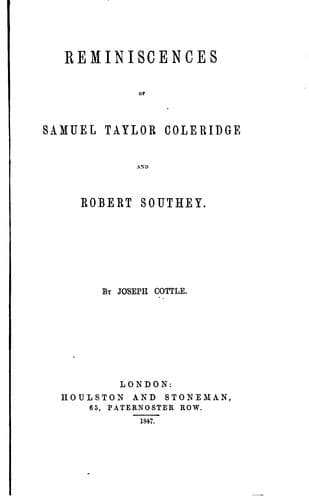
Reminiscences of Samuel Taylor Coleridge and Robert SoutheyCottle, Joseph
General
Reminiscences of Samuel Taylor Coleridge and Robert Southey
Cottle, Joseph
Authors, English -- 19th century -- Biography; Coleridge, Samuel Taylor, 1772-1834; Southey, Robert, 1774-1843
To Joseph Cottle.
Robert Southey."
"London, March 6, 1797.
... I am inclined to complain heavily of you, Cottle. Here am I
committing grand larceny on my time, in writing to you; and you, who
might sit at your fire, and write me huge letters, have not found time to
fill even half a sheet. As you may suppose, I have enough of employment.
I work like a negro at law, and therefore neglect nothing else, for he
who never wastes time has always time enough.
I have to see many of the London lions, or literati, George Dyer is to
take me to Mary Hayes, Miss Christal, and Taylor, the Pagan, my near
neighbour. You shall have my physiognomical remarks upon them. I hate
this city more and more, although I see little of it. You do not know
with what delight I anticipate a summer in Wales, and I hope to spend the
summer of the next year there, and to talk Welsh most gutturally. I shall
see Meirion this week, whose real name is William Owen. He is the author
of the new Welsh dictionary, a man of uncommon erudition, and who ought
to esteem me for Madoc's sake. Fare you well. Remember me to all friends.
God bless you.
Yours sincerely,
Robert Southey."
"... Perhaps you will be surprised to hear, that of all the lions of
literati that I have seen here, there is not one whose countenance has
not some unpleasant trait. Mary Imlay is the best, infinitely the best.
The only fault in it, is an expression somewhat similar to what the
prints of Horne Tooke display; an expression indicating superiority, not
haughtiness, not conceit, not sarcasm, in Mary Imlay, but still it is
unpleasant. Her eyes are light brown, and though the lid of one of them
is affected by a slight paralysis, they are the most meaning I ever saw.
Her complexion is dark, sun-burnt, and her skin a little cracked, for she
is near forty, and affliction has borne harder on her than years; but her
manners are the most pleasing I ever witnessed, they display warm
feeling, and strong understanding; and the knowledge she has acquired of
men and manners, ornaments, not disguises, her own character. I have
given an unreserved opinion of Mrs. Barbauld to Charles Danvers.
Public-domain text, read in full here on John Shaqi.
Reviews
Reviews
No reviews yet
Be the first to share your thoughts on this work.
Elsewhere in the archive
Join the Discussion
Join the discussion
Sign in to leave a comment or review.
Sign InorCreate an account