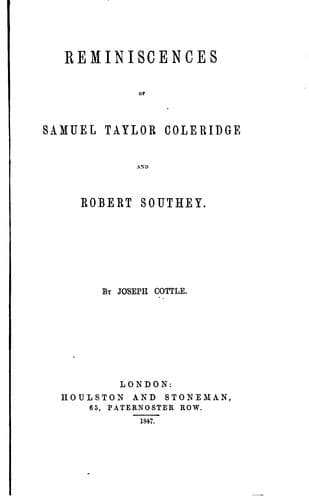
Reminiscences of Samuel Taylor Coleridge and Robert SoutheyCottle, Joseph
General
Reminiscences of Samuel Taylor Coleridge and Robert Southey
Cottle, Joseph
Authors, English -- 19th century -- Biography; Coleridge, Samuel Taylor, 1772-1834; Southey, Robert, 1774-1843
While I was with George Dyer one morning last week, Mary Hayes and Miss
Christal entered, and the ceremony of introduction followed. Mary Hayes
writes in the New Monthly Magazine, under the signature of M. H., and
sometimes writes nonsense there about Helvetius. She has lately published
a novel, 'Emma Courtney,' a book much praised and much abused. I have not
seen it myself, but the severe censure passed on it by persons of narrow
mind, have made me curious, and convinced me that it is at least an
uncommon book. Mary Hayes is an agreeable woman and a Godwinite. Now if
you will read Godwin's book with attention, we will determine between us,
in what light to consider that sectarian title. As for Godwin himself, he
has large noble eyes, and a nose,--oh, most abominable nose! Language is
not vituperative enough to express the effect of its downward elongation.
He loves London, literary society, and talks nonsense about the collision
of mind, and Mary Hayes echoes him.
But Miss Christal, have you seen her Poems? A fine, artless, sensible
girl. Now, Cottle, that word sensible must not be construed here in its
dictionary acceptation. Ask a Frenchman what it means, and he will
understand it, though, perhaps, he can by no circumlocution explain its
French meaning. Her heart is alive. She loves poetry. She loves
retirement. She loves the country. Her verses are very incorrect, and the
literary circle say, she has no genius, but she has genius, Joseph
Cottle, or there is no truth in physiognomy. Gilbert Wakefield came in
while I was disputing with Mary Hayes upon the moral effects of towns. He
has a most critic-like voice, as if he had snarled himself hoarse. You
see I like the women better than the men. Indeed they are better animals
in general, perhaps because more is left to nature in their education.
Nature is very good, but God knows there is very little of it left.
I wish you were within a morning's walk, but I am always persecuted by
time and space. Robert Southey, and law, and poetry, make up an odd kind
of tri-union. We jog on easily together, and I advance with sufficient
rapidity in Blackstone, and 'Madoc.' I hope to finish my poem, and to
begin my practice in about two years.
God bless you.
Yours affectionately,
Robert Southey."
"... I am running a race with the printers again: translating a work from
the French: 'Necker on the French Revolution,' vol. II. Dr. Aikin and his
son translate the 1st volume. My time is wholly engrossed by the race,
for I run at the rate of sixteen pages a day; as hard going as sixteen
miles for a hack horse. About sixteen days more will complete it.
Public-domain text, read in full here on John Shaqi.
Reviews
Reviews
No reviews yet
Be the first to share your thoughts on this work.
Elsewhere in the archive
Join the Discussion
Join the discussion
Sign in to leave a comment or review.
Sign InorCreate an account