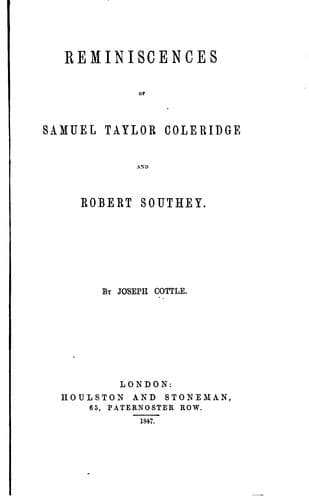
Reminiscences of Samuel Taylor Coleridge and Robert SoutheyCottle, Joseph
General
Reminiscences of Samuel Taylor Coleridge and Robert Southey
Cottle, Joseph
Authors, English -- 19th century -- Biography; Coleridge, Samuel Taylor, 1772-1834; Southey, Robert, 1774-1843
I cannot here withhold an ungracious piece of information. In the
prospect of this establishment, great expectations had been raised, and
the afflicted of all descriptions, were taught to expect a speedy cure;
so that when the doors were opened, no less than seventy or eighty
patients, progressively applied for the gratuitous alleviation of their
maladies. But it is too great a tax on human patience, when cures are
always promised, but never come. No one recovery, in an obstinate case,
had occurred: in consequence of which, many patients became dissatisfied,
and remitted their attendance. Independently of which, an idea had become
prevalent amongst the crowd of afflicted, that they were merely made the
subjects of experiment, which thinned the ranks of the old applicants,
and intimidated new. It might be said, that patients after a certain
period had so ominously declined, that the very fire was likely to become
extinguished for want of fuel. In order that the trials might be
deliberately proceeded in, a fortunate thought occurred to Dr. Beddoes;
namely, not to _bribe_, but to _reward_ all persevering patients; for Mr.
Davy informed me, that, before the Pneumatic Institution was broken up,
they allowed every patient sixpence per diem; so that when all hopes of
cure had subsided, it became a mere pecuniary calculation with the
sufferers, whether, for a parish allowance of three shillings a week,
they should submit or not, to be drenched with these nauseous gases.
This Pneumatic Institution, though long in a declining state, protracted
its existence for more than two years, till the departure from Bristol of
Mr. D., and then by its failure, it established the useful negative fact,
however mortifying, that medical science was not to be improved through
the medium of factitious airs.
I happened to be present when Mr. W. Coates casually named to Mr. Davy,
then just turned of twenty, that his boy the preceding evening, had
accidentally struck one piece of cane against another, in the dark, and
which produced light. It was quite impressive to notice the intense
earnestness with which Mr. D. heard this fact which, by others, might
have been immediately forgotten. Mr. D. on the contrary, without
speaking, appeared lost in meditation. He subsequently commenced his
experiments on these canes, and thus communicated the results to his
friend Mr. Giddy, (now Gilbert).
"My dear friend,
... I have now just room to give you an account of the experiments I have
lately been engaged in.
_First_. One of Mr. Coates's children accidentally discovered that two
bonnet-canes rubbed together produced a faint light. The novelty of this
experiment induced me to examine it, and I found that the canes, on
collision, produced sparks of light, as brilliant as those from flint and
steel.
_Secondly_. On examining the epidermis, I found, when it was taken off,
that the canes no longer gave light on collision.
Public-domain text, read in full here on John Shaqi.
Reviews
Reviews
No reviews yet
Be the first to share your thoughts on this work.
Elsewhere in the archive
Join the Discussion
Join the discussion
Sign in to leave a comment or review.
Sign InorCreate an account