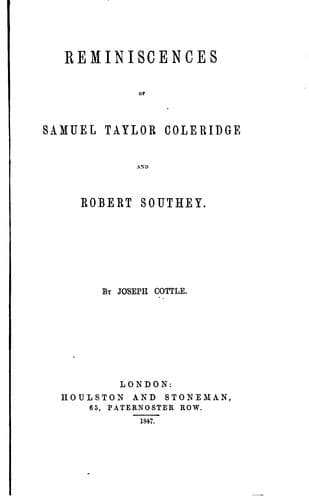
Reminiscences of Samuel Taylor Coleridge and Robert SoutheyCottle, Joseph
General
Reminiscences of Samuel Taylor Coleridge and Robert Southey
Cottle, Joseph
Authors, English -- 19th century -- Biography; Coleridge, Samuel Taylor, 1772-1834; Southey, Robert, 1774-1843
_Thirdly_. The epidermis, subjected to chemical analysis, had all the
properties of silex.
_Fourthly_, The similar appearance of the epidermis of reeds, corn, and
grasses, induced me to suppose that they also contained silex. By burning
them carefully and analyzing their ashes, I found that they contained it
in rather larger proportions than the canes.
_Fifthly_. The corn and grasses contain sufficient potash to form glass
with their flint. A very pretty experiment may be made on these plants
with the blowpipe. If you take a straw of wheat, barley, or hay, and burn
it, beginning at the top, and heating the ashes with a blue flame, you
will obtain a perfect globule of hard glass, fit for microscopic
discovery."
The circumstance, that all canes, as well as straws and hollow grasses,
have an epidermis of silex, is one of the most singular facts in nature.
Mr. Davy, in another place, has stated the advantages arising to this
class of vegetables, from their stony external concretion: namely, "the
defence it offers from humidity; the shield which it presents to the
assaults of insects; and the strength and stability that it administers
to plants, which, from being hollow, without this support, would be less
perfectly enabled to resist the effect of storms.
Those canes which are not hollow, are long and slender, and from wanting
the power to sustain themselves, come usually in contact with the ground,
when they would speedily decay, from moisture, but from the impenetrable
coat of mail with which nature has furnished them. But questions still
arise for future investigators. How came the matter of flint to invest
those plants which most need it, and not others? Whence does this silex
come? Is it derived from the air, or from water, or from the earth? That
it emanates from the atmosphere is wholly inadmissible. If the silex
proceed from water, where is the proof? and how is the superficial
deposit effected? Also, as silex is not a constituent part of water, if
incorporated at all, it can be held only in solution. By what law is this
solution produced, so that the law of gravity should be suspended? If the
silex be derived from the earth, by what vessels is it conveyed to the
surface of the plants? and, in addition, if earth be its source, how is
it that earth-seeking, and hollow plants, with their epidermis of silex,
should arise in soils that are not silicious? being equally predominant,
whether the soil be calcareous, argillaceous, or loamy. The decomposition
of decayed animal and vegetable substances, doubtless composes the
richegt superficial mould; but this soil, so favorable for vegetation,
gives the reed as much silex, but no more, in proportion to the size of
the stalk, than the same plants growing in mountainous districts, and
primitive soils. It is to be regretted, that the solution of these
questions, with others that might be enumerated, had not occupied the
profoundly investigating spirit of Mr. Davy; but which subjects now offer
Public-domain text, read in full here on John Shaqi.
Reviews
Reviews
No reviews yet
Be the first to share your thoughts on this work.
Elsewhere in the archive
Join the Discussion
Join the discussion
Sign in to leave a comment or review.
Sign InorCreate an account